
Compare guides
Head-to-head hardware and software decisions.
Start With the Room, Not the Budget
A simulator bay fails when the hardware fights the space. Before comparing launch monitors or projectors, fix the dimensions. The minimum ceiling is 9 feet; 10 feet is comfortable for a full swing. Bay width should land between 10 and 12 feet. Depth needs 14 to 18 feet so you can separate the hitting area from the screen and the equipment behind it. Place the screen 8 to 10 feet from the ball, the monitor 6 to 8 feet behind the ball, and specify a projector between 3,000 and 5,000 lumens.
Those numbers create the first trade-off. A deeper room gives radar launch monitors the ball flight they need to read spin and carry accurately, but it costs more square footage and a brighter projector to fill the screen at distance. A shallower room suits photometric cameras, which capture impact data at the ball, yet you lose some realism in ball-flight visualization. There is no universal “right” depth; there is only the depth that matches the sensor technology you can afford and the space you actually own.
Software is the second variable. Some systems require annual subscriptions for course play, club data, or online competition. Others include core features upfront but charge for premium add-ons later. The difference between a $500 yearly software fee and a $0 fee is $2,500 over five years—enough to swing a hardware decision.
Match the Sensor to Your Depth and Lighting
Photometric and radar launch monitors measure golf differently, and that difference dictates your build. Cameras photograph the ball at impact, so they work in tighter bays and lower ambient light. Radar tracks the ball through flight, so it needs room to breathe and performs best with consistent lighting and unobstructed ball flight.
| Factor | Photometric | Radar |
| Measurement point | Ball at impact | Ball through flight |
| Minimum room depth | 10–12 ft | 14–18 ft |
| Lighting sensitivity | Lower | Higher |
| Club data | Inferred or limited | Direct and detailed |
| Typical price class | Mid to high | Mid to high |
If your bay is on the shallow end—say 14 feet deep with a screen at 8 feet—a photometric system is the safer fit. Radar will struggle to track ball flight before the net or screen interrupts it. If you have 16 to 18 feet and controlled lighting, radar can deliver more complete club and ball data, but you will need a projector toward the 5,000-lumen end of the range to maintain image brightness at that throw distance. Read the full sensor breakdown here.
Compare Price Against Real Usage
Hardware sticker prices rarely tell the full story. The SkyTrak+ costs roughly six times what the Garmin R10 costs, yet both can measure ball data. The gap appears in club metrics, software subscriptions, and accuracy under pressure.
A buyer who plays mostly solo in a 12-foot-wide bay and wants basic carry and spin numbers may find the R10 sufficient, especially if the room is shallow and lighting is variable. A buyer who teaches, fits clubs, or wants multiplayer accuracy in a dedicated 18-foot bay will likely justify the SkyTrak+ premium—but only if they also budget for the yearly software cost and the physical space to support it.
| Decision point | Garmin R10 path | SkyTrak+ path |
| Upfront cost | Low | High |
| Annual software | Optional or low | Recurring |
| Club data depth | Basic | Advanced |
| Room depth need | Flexible | Moderate |
The right choice depends on how many rounds you will play per year and whether you need club-path data or just ball flight. If you play 20 times a year, a subscription amortizes quickly. If you play 60 times, the hardware accuracy gap matters more than the annual fee. See the direct comparison here.
FAQ
What ceiling height do I need? Nine feet is the absolute minimum; ten feet is comfortable for most swings without fear of clipping the ceiling.
How far should the screen be from the ball? Eight to ten feet. Closer risks image distortion and safety issues; farther requires a brighter projector.
Which launch monitor works in a shallow bay? Photometric systems measure at impact and suit tighter rooms. Radar needs 14 to 18 feet of depth to track flight properly.
Before you compare two products, write down the four measurements that cannot change: ceiling to the lowest obstruction, bay width, bay depth, and the distance from the ball to the screen. A monitor that wins on accuracy but needs two feet more depth than you have is not a candidate. The comparison starts with the room.
All compare guides
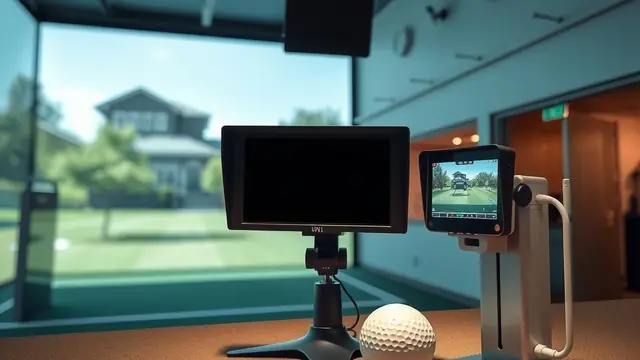
Photometric vs radar launch monitors
Cameras measure the ball at impact; radar tracks it through flight. The difference decides your room depth, lighting, club data, and price.
Read the guide →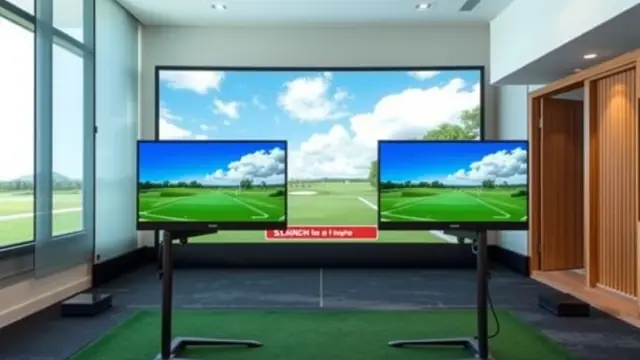
SkyTrak vs Garmin R10
SkyTrak+ costs six times what the Garmin R10 does. The right pick depends on room depth, club data, and how much you will pay every year.
Read the guide →