
Hardware guides
Launch monitors, projectors, screens, mats, and enclosures.
Start with the room, not the gear
Every hardware decision in a home bay is a room decision first. A standard garage or spare room usually gives you a width of 10 to 12 ft and a depth of 14 to 18 ft. That envelope fixes where the screen, ball, monitor, and projector can physically go.
Ceiling height is the hardest constraint. Nine feet is the absolute minimum; ten feet is comfortable. If you are under nine feet, a high-lofted driver or a tall player’s follow-through becomes a liability, and ceiling-mounted launch monitors may not clear the swing plane.
Depth creates a chain of fixed distances. The screen sits 8 to 10 ft from the ball. The launch monitor sits 6 to 8 ft behind the ball. That leaves only a few feet of buffer in a 14 ft room before you hit the back wall. In an 18 ft room, you gain space for spectator seating or a second hitting position, but you also need a brighter projector to fill the same screen from farther back.
Launch monitor, projector, and screen: the imaging triangle
Launch monitors split into two room types. Radar units sit behind the ball and need the full 6 to 8 ft of depth to track ball flight accurately; they work well in deeper bays but struggle in shallow rooms. Camera and optical units mount overhead or beside the hitting area and need less rear depth, but they require precise ceiling height and a clear view of the impact zone.
The projector must match the screen and the throw distance. For a 10 to 12 ft wide bay, plan on 3000 to 5000 lumens. Below 3000 lumens, the image washes out in ambient light; above 5000 lumens, you pay for brightness you do not need in a light-controlled room. Throw ratio determines whether the projector can sit on a shelf behind the hitting area or must be ceiling-mounted close to the screen. Input lag matters more than resolution: a 4K image with 40 ms of lag feels disconnected, while a 1080p image with 16 ms of lag reads instantly.
Screen size is bounded by the frame, not by what looks impressive. In a 10 to 12 ft bay, an 8 to 10 ft wide screen leaves enough margin to avoid crowding the frame and to keep errant shots from punching through the edge. Ball-speed rating matters: a screen rated for lower ball speeds will wear out faster if you regularly hit driver over 150 mph.
| Component | Key spec | Room impact |
|---|---|---|
| Launch monitor | Radar vs. camera; 6–8 ft behind ball | Radar needs depth; camera needs ceiling clearance |
| Projector | 3000–5000 lumens; throw ratio | Short throw fits shallow bays; long throw needs rear shelf space |
| Screen | 8–10 ft from ball; 8–10 ft wide | Wider screens need wider bays and stronger frames |
Mat, enclosure, and the trade-offs you cannot ignore
The hitting mat decides how your body feels after a winter of practice. A thin mat with a fixed hitting strip transfers shock to elbows and wrists; a thick mat with a replaceable strip absorbs impact and lets you swap the worn hitting area without replacing the whole surface. Turf type affects club interaction: dense, short turf mimics fairway lies, while longer turf can grab the club and alter swing feel indoors.
Enclosures stop balls, contain noise, and protect walls. A DIY frame with netting costs less but requires you to source and tension the screen yourself. A kit includes frame, netting, screen, and ceiling protection, usually at a premium, but it ships with tested safety ratings and consistent tension. If your bay shares a wall with a living space or a bedroom, invest in ceiling protection and side netting; a missed shot or a bounce-back can damage drywall and end a practice session quickly.
These choices constrain each other. A ceiling-mounted camera monitor reduces rear depth needs but uses ceiling height you may not have. A high-lumen projector handles a larger screen but generates more heat and fan noise in a small room. A thick joint-saving mat raises the hitting surface, which can reduce effective ceiling clearance for taller players.
FAQ
What is the minimum ceiling height?
Nine feet. Ten feet is comfortable and gives safer clearance for driver swings and ceiling-mounted monitors.
How far from the ball should the screen be?
Eight to ten feet. That distance balances image size with ball-speed safety and frame clearance in a 10 to 12 ft bay.
How many lumens does the projector need?
Three thousand to five thousand lumens. Less washes out in a typical garage; more is unnecessary for a light-controlled bay.
All hardware guides
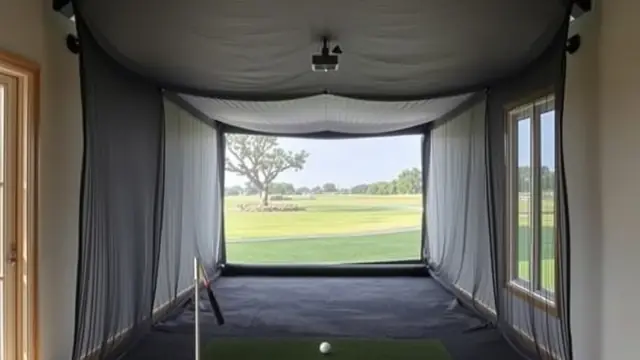
Golf Simulator Netting: Buying and Installation Guide
Choose simulator netting by mesh, ball speed, and mounting method, with containment rules for walls, ceilings, and frames.
Read the guide →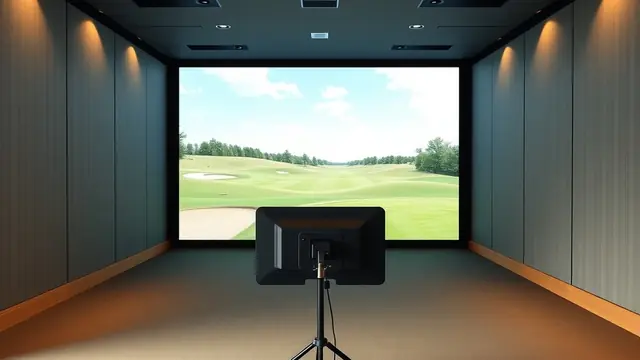
Best launch monitors for a home bay
Five launch monitors that fit a real home bay, from the $500 Garmin R10 to a ceiling-mounted camera, sorted by room depth and budget.
Read the guide →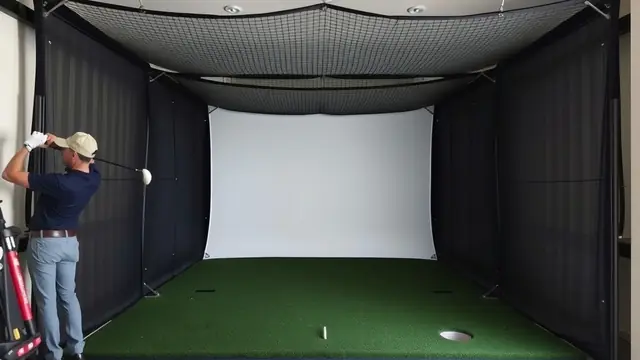
Golf simulator enclosures: DIY vs kit
Frame, netting, screen, and ceiling protection: what a home enclosure has to stop, what the parts cost, and when a kit is worth it.
Read the guide →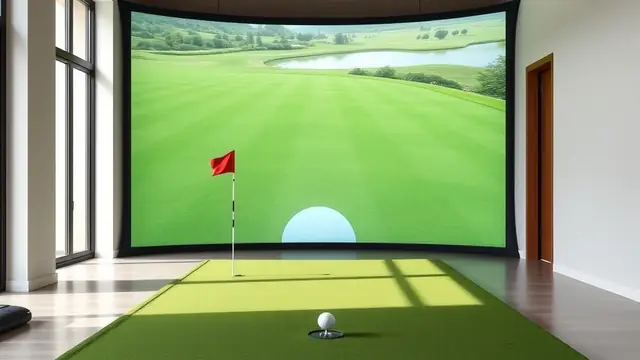
Golf simulator mats that save your joints
How mat thickness, turf type, and a replaceable hitting strip decide whether your elbows survive a winter of indoor golf.
Read the guide →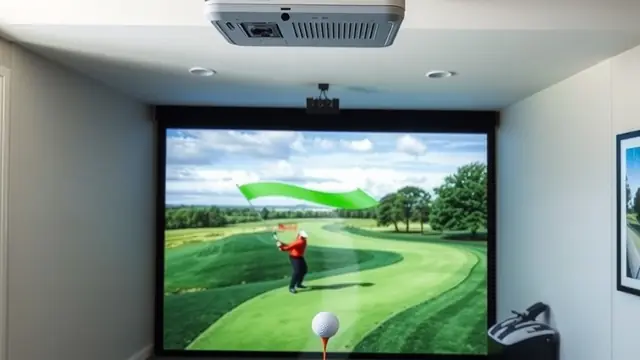
Golf simulator projector: lumens, throw, lag
How many lumens a 10 to 12 ft screen needs, which throw ratio fits your bay, and why input lag and lamp type matter more than resolution.
Read the guide →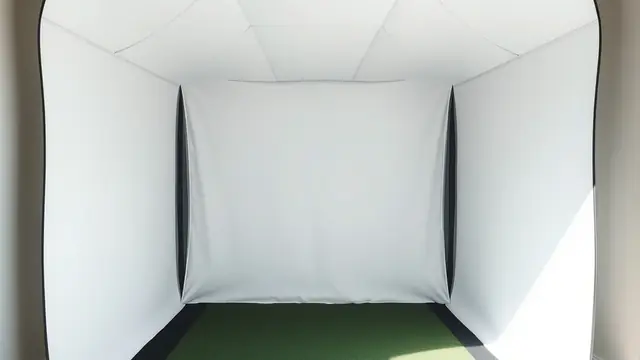
Golf simulator screens: impact and size
What impact screens are made of, how to read a ball-speed rating, and what screen size fits a 10 to 12 ft bay without crowding the frame.
Read the guide →