Golf simulator enclosures: DIY vs kit
Frame, netting, screen, and ceiling protection: what a home enclosure has to stop, what the parts cost, and when a kit is worth it.
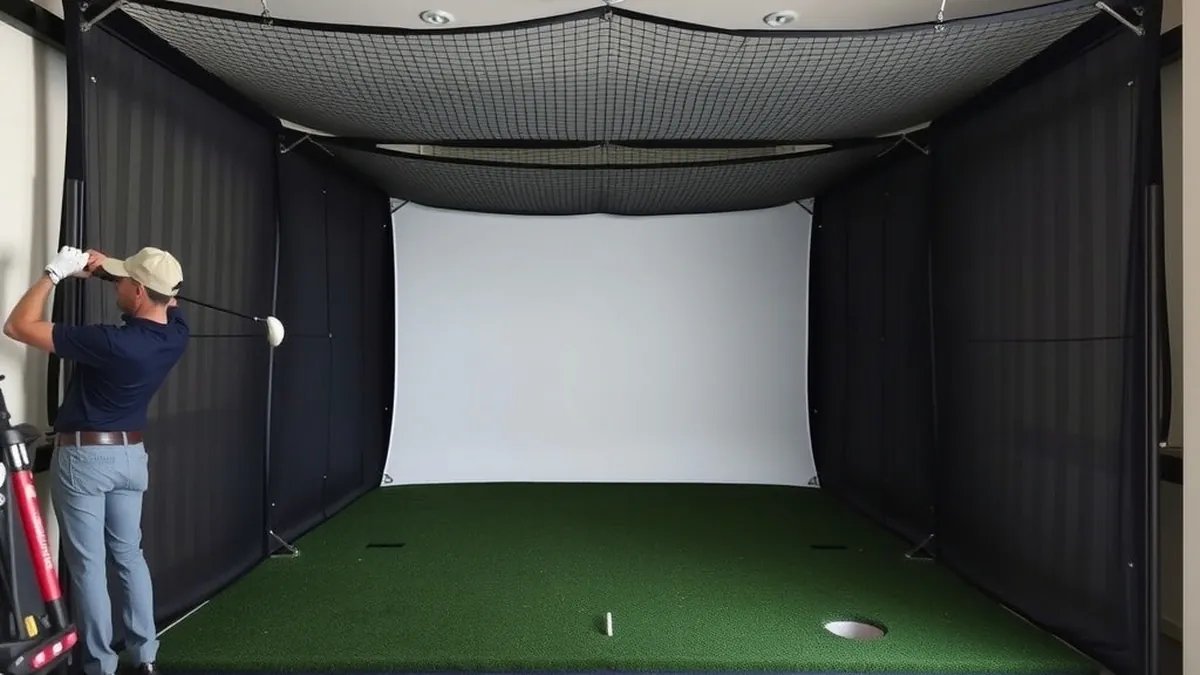
A safe enclosure needs a frame anchored to studs, a back net that stops the ball, a screen 6 to 12 inches in front of it, and side plus ceiling protection. A 10 by 12 by 9 foot DIY build runs $2,000 to $3,000.
- Minimum bay
- 10 ft wide × 12 ft deep × 9 ft high
- Ball to screen
- 8–10 ft
- Screen to net gap
- 6–12 in.
- DIY materials
- $2,000–$3,000
- Kit
- $3,000–$6,500
Some links on this page are affiliate links.If you buy through them we may earn a commission at no extra cost to you. We do not accept payment for rankings. Read the full disclosure.
An enclosure is three systems pretending to be one: a frame that holds its shape, netting that stops the ball, and a screen that shows the shot. Most buyers budget the screen first and the netting last, which is backwards.
A golf simulator enclosure is the structural box around the hitting area: frame, back net, impact screen, side and ceiling netting, and the ballast that keeps the whole thing from walking across the floor.
What an enclosure has to stop
A 45.9 gram golf ball at 160 mph carries about 120 joules. That energy has to go somewhere in the 8 to 10 feet between the ball and the back of the bay, and the enclosure’s job is to spread the stop over as much distance and as many layers as possible.
Two layers do that. The impact screen takes the first hit and dissipates some energy through its weave. A separate net 6 to 12 inches behind it catches whatever the screen passes or stretches toward. A screen with no net behind it is a display, not a barrier.
Frame: EMT pipe vs aluminum kit
One and a half inch EMT conduit is the DIY standard. It costs roughly $30 to $40 per 10 foot length, cuts with a hacksaw, and joins with slip-on fittings that need no welding. A 10 by 12 by 9 foot frame uses about 10 lengths plus 10 fittings.
The weakness is the span. A 10 foot top beam carrying a tensioned screen and netting will sag in the middle, and sag changes screen tension. Add a center upright, or step up to 2 inch pipe on the top beam.
Aluminum extrusion kits solve that with engineered profiles and bolt-together corners. They are straighter, repeatable, and easy to take down, and the frame alone can cost $1,500 to $3,000.
Either way, the frame must be anchored into studs or ceiling structure, not drywall, and every foot needs ballast or a floor anchor. A 9 foot tall frame with 400 square feet of netting is a sail.
Netting and the screen are two different jobs
For the back wall, use 1 inch mesh nylon rated #30 or heavier. A 1.68 inch ball is uncomfortably close to the opening of 1-3/4 inch knotted netting, so leave that gauge for side panels where the ball arrives at an angle.
The screen is usually a three-ply woven polyester with grommets every 12 inches. Hang it with bungee cord, not rope, so it can flex on impact. Tension it evenly: a screen with loose corners balloons and wears at the grommets.
Leave a 4 to 6 inch gap at the bottom of both layers. Balls that hit low should drop and roll back, not rebound at shin height.
Ceiling and side protection
A 56 degree wedge launched from 8 feet in front of a 9 foot ceiling hits the ceiling about halfway to the screen. That is not a mishit; it is a normal wedge. Cover the wedge zone with a ceiling net or drapes running from the front edge of the bay back at least 8 feet.
Side nets matter most near the player. A shanked iron leaves at a shallow angle and stays low, so full-height side panels for the first 6 feet of the bay catch more balls than tall corners at the far end.
Watch the garage door. Tracks and opener rails commonly sit at 7 feet 6 inches, below the ceiling and inside the swing arc. Do not hang anything from them, and check the track with a practice swing before you tension a single net.
Ball containment: distance beats gauge
Doubling the distance a ball travels before it stops roughly halves the average force, which is why 10 feet is safer than 6 feet even with the same netting. If the room only allows 6 feet, add a second net layer and accept that the screen will wear faster.
Angled side nets help, too. A panel set at 15 to 20 degrees deflects the ball down and inward instead of straight back. Never aim a shot at a corner where two panels meet; that is where seams fail.
What it costs
Planning estimate for a 10 foot wide, 12 foot deep, 9 foot high DIY bay. Prices are typical US retail, not quotes.
| Part | Specification | Quantity | Estimate |
|---|---|---|---|
| EMT conduit | 1-1/2 in. × 10 ft | 10 | $350 |
| Frame fittings | 3-way corners, tees, crosses | 10 | $260 |
| Back and side netting | 1 in. mesh, #30 nylon, ~440 sq ft | 1 lot | $450 |
| Impact screen | 8 × 10.5 ft, grommeted | 1 | $600 |
| Bungee and clips | 1/4 in., 100 ft | 1 | $60 |
| Ballast | 50 lb bags, sand filled | 4 | $90 |
| Hitting mat | 5 × 5 ft platform with strip | 1 | $800 |
| Projector mount and cable | Ceiling mount, 35 ft HDMI | 1 | $130 |
| Total | ~$2,740 |
That total excludes the projector, launch monitor, and computer. A kit with the same footprint runs $3,000 to $6,500 depending on frame material and screen grade; a custom installed enclosure starts around $8,000.
For the display side, our screen guide covers gain, aspect ratio, and why a 4:3 screen wastes less wall than 16:9. The mat guide explains the strip that keeps your elbows intact, and the bay dimensions guide has the minimum and comfortable room sizes.
Safety checks before the first swing
Pull hard on every net edge; if a clip slips by hand, it will slip under a ball. Confirm the frame cannot tip: four 50 pound bags is a starting point, not a guarantee. Check that no one can walk into the bay from behind the screen, and keep the area behind the screen clear of stored clubs and shelving.
Electrical work is the other line. A projector, lights, and a monitor on one garage circuit will trip it, and extension cords across a wet floor are how people get hurt. Have a licensed electrician run dedicated circuits to local code; NFPA 70 is the baseline most jurisdictions adopt.
The short version
Build the frame rigid, anchor it to structure, hang a real net behind the screen, and cover the ceiling over the wedge zone. Distance from ball to screen buys more safety than thicker netting. Budget $2,000 to $3,000 for a DIY bay this size, or $3,000 to $6,500 for a kit, and spend the difference on a mat you will not have to replace in a year.
How to do it
- Measure and mark the bayConfirm ceiling height, bay width, and 8 to 10 feet from ball to screen before you cut any pipe or order netting.
- Assemble the frame on the floorLay out the uprights and beams, fit the corners, then raise the frame and anchor it into studs rather than drywall.
- Hang the back net firstStretch the net tight to the frame with bungees, leaving a 4 to 6 inch gap at the floor so balls drop instead of rebounding.
- Hang the screen in front of the netKeep 6 to 12 inches between screen and net, and tension the screen evenly so it does not balloon on impact.
- Add side and ceiling protectionFit full-height side nets for the first 6 feet and a ceiling net over the wedge zone, then ballast every frame foot.
Frequently asked questions
How much does a golf simulator enclosure cost?
A 10 by 12 by 9 foot DIY enclosure runs about $2,000 to $3,000 in materials, including netting, screen, frame, and ballast but not the mat or projector. A comparable kit runs $3,000 to $6,500, and a custom installed enclosure starts around $8,000.
Can I build a simulator enclosure from EMT conduit?
Yes. One and a half inch EMT is strong enough for a 10 foot bay when the top beam is supported at the center. It cuts with a hacksaw, joins with slip-on fittings, and costs a fraction of aluminum extrusion, but it must be anchored to studs and ballasted.
Do I need a net behind the impact screen?
Yes. The screen displays the shot; the net stops it. A screen alone will pass or tear on a driver, so hang a net 6 to 12 inches behind the screen and treat the screen as the front layer of a two-layer system.
How far should the ball be from the screen?
Eight feet is the minimum and 10 feet is better. At 8 feet a driver is still near full speed, so the net has to absorb roughly 120 joules over a short distance. More distance means less peak force on every layer.
How tall do the side nets need to be?
Full height for the first 6 feet of the bay, measured back from the screen, then they can taper. A shanked iron leaves at a shallow angle and travels sideways fast, which is why the side panels near the player matter more than the far corners.
Can I hang an enclosure from garage door tracks?
No. Garage door tracks and opener rails are not rated for a lateral load, and they often sit at 7 feet 6 inches, below your ceiling. Build a freestanding frame or anchor into the ceiling structure with a contractor's advice.
Sources
Some links are affiliate links.If you buy through them we may earn a commission at no extra cost to you. We do not accept payment for rankings. Read the full disclosure.