Golf simulator mats that save your joints
How mat thickness, turf type, and a replaceable hitting strip decide whether your elbows survive a winter of indoor golf.
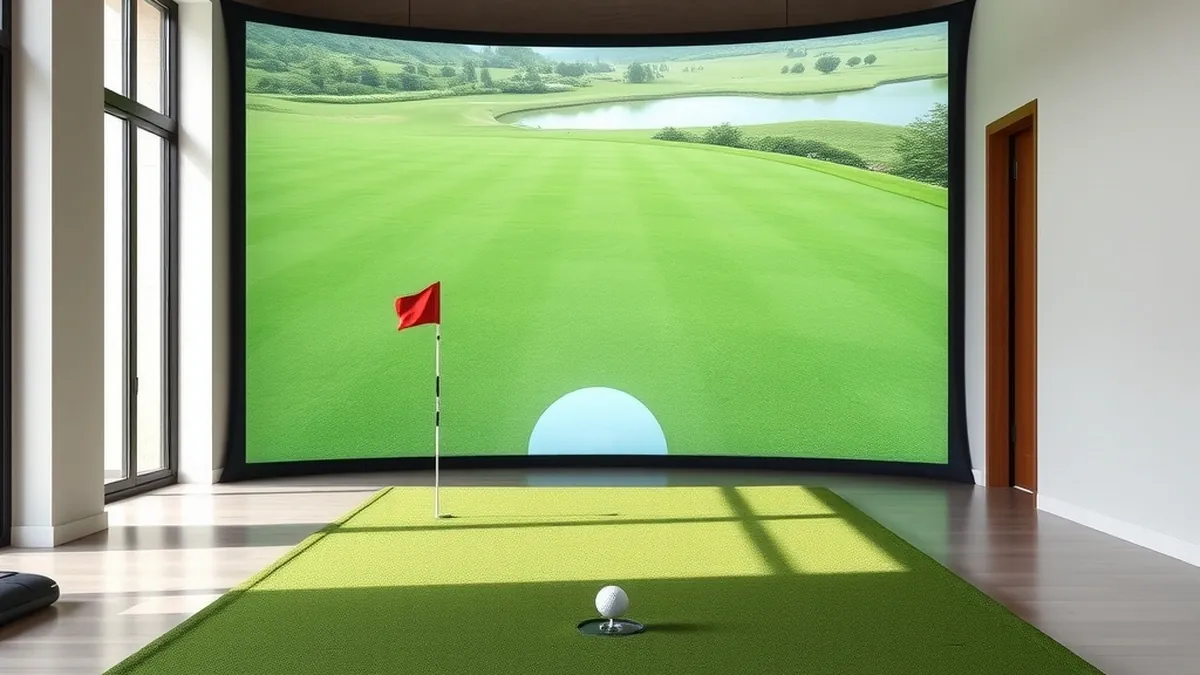
A simulator mat needs 1.25 to 1.75 inches of dense material under the ball, not carpet over concrete. A replaceable 12 by 36 inch strip set flush into a stance platform is cheapest over five years.
- Minimum for full swings
- 5/8 in., rubber-backed
- Commercial target
- 1.25–1.75 in., dense core
- Hitting strip
- 12 × 36 in., replaceable
- Strip replacement
- $150–$300
Some links on this page are affiliate links.If you buy through them we may earn a commission at no extra cost to you. We do not accept payment for rankings. Read the full disclosure.
You can spend $25,000 on a launch monitor and still wreck your winter on a $79 mat. The mat is the only part of the simulator your body touches, and it is the part most buyers treat as an afterthought.
A golf simulator hitting mat is the turf assembly you stand on and strike from: a stance area under your feet, a denser ball area under the clubhead, and on good mats a replaceable strip where the divot actually happens.
Why a cheap mat hurts your elbow
A thin roll of turf over a concrete slab has nowhere to give. The clubhead arrives at 90 mph or more, the sole catches the surface, and the shaft stops in a few inches. The energy that should have gone into the ground and the turf goes into your hands, wrists, and elbows instead.
Do that 80 times in a session, three nights a week, and the load adds up. Golfer’s elbow is a tendon problem, not a bruise, and it does not announce itself on the first fat shot. It shows up as soreness the next morning that lasts a little longer each week.
None of this is a diagnosis. If you already have elbow or wrist pain, see a clinician; a mat is not treatment. But the mechanism is worth understanding before you buy, because the difference between a $79 mat and a $900 mat is mostly the difference between a hard stop and a controlled one.
What mat thickness actually buys you
Thickness is a proxy for travel: how far the clubhead can keep moving after it touches the mat before something rigid stops it.
- 3/8 inch or less. This is carpet. It looks like turf and behaves like concrete with a green cover. Fine for putting, wrong for full swings.
- 5/8 to 3/4 inch. The practical minimum for regular practice. Rubber-backed mats in this range feel firm and predictable, but they still transmit a sharp impact.
- 1.25 to 1.75 inch. Commercial range. The better examples combine a dense base with a fiber or gel layer that deforms locally under the club.
Density matters as much as thickness. A 1.5 inch open-cell foam mat feels wonderful in the store and collapses into a trench at the ball line within a season. Closed-cell foam, rubber crumb, and dense fiber hold their shape.
There is a failure mode in the other direction, too. A mat soft enough to swallow the clubhead produces fat shots and a low point that wanders. You want the club to pass through the surface, not sink into it.
Turf types, ranked by forgiveness
Prices below are typical US retail ranges for a 5 by 5 foot mat, not quotes. They move with size and shipping.
| Turf type | Thickness | How it behaves | Typical price |
|---|---|---|---|
| Roll turf over concrete | 3/8 in. | Club bounces; shock goes to the hands | $60–$150 |
| Interlocking foam tile | 1/2–3/4 in. | Soft underfoot, inconsistent bounce | $80–$200 |
| Rubber-backed turf | 5/8–3/4 in. | Firm and predictable, still sharp | $250–$500 |
| Gel or foam-core mat | 1–1.5 in. | Absorbs impact, can feel mushy | $400–$900 |
| Nylon brush turf | 1.25–1.75 in. | Club passes between bristles | $1,000–$2,000 |
| Strip-in-platform system | 1.25 in. platform | Disposable strip, stable stance | $700–$1,500 |
Flat polypropylene turf is the default because it is cheap and photographs well. It also produces the most friction under the sole, which is exactly the wrong quality at the ball.
Nylon brush turf, the style Fiberbuilt builds its reputation on, stands in short bristles so the clubhead passes between them rather than bouncing off a surface. The company’s product literature describes the turf as designed to let the club travel through impact; owners report that fat shots feel like a miss rather than a jolt. It is neither indestructible nor cheap.
The middle option is a dense, short-pile turf over a one-inch foam or gel core. It reads as more realistic than bristles and absorbs more than a flat mat. It also wears in a visible line within a year of heavy use.
Stance area vs ball area
Most wear happens in a rectangle about 12 inches wide and 36 inches long along your ball line. Your stance area takes load too, but it compresses evenly and slowly. The ball line craters.
That is why a single 5 by 5 foot mat is the wrong shape for a simulator. It fuses the disposable part and the durable part into one piece, so you replace the whole thing when only a strip is dead.
A better design is a stance platform with a recessed strip. The strip drops in flush, sits at the same height as the turf under your feet, and can be rotated 180 degrees to move the wear. Ball and feet stay on one plane, which matters more than most buyers expect: a strip laid on top of a mat raises the ball an inch and quietly changes your swing.
Replacing a worn strip
If your mat uses a drop-in strip, replacement is a five-minute job and a $150 to $300 part. Order the same thickness and cut, not a generic insert.
If it does not, you can still replace a section. Mark a clean rectangle around the worn area with a straightedge, cut through with a utility knife, and lift the old piece. Bed the new strip on contact adhesive, match thickness within 1/8 inch, and seam the edges with turf tape. Rotate a one-sided strip before you cut it, because the wear is usually concentrated at one end.
DIY vs commercial
The DIY version is a 3/4 inch rubber horse stall mat with turf glued on top. Materials run $200 to $400 for a 4 by 6 foot area. It is heavy, stable, and fine for wedge practice into a net.
What it does not have is controlled give. Rubber that dense exists to protect a barn floor from hooves, not to absorb a 7-iron. The turf also needs a proper adhesive, or it creases and slides at the edges.
A commercial mat with a replaceable strip runs $700 to $1,500, and strips are $150 to $300. The DIY mat will need its turf re-glued or replaced within a few years, so the price gap narrows; what does not narrow is the impact feel.
Matching the mat to the rest of the bay
The mat sets your ball position, and ball position sets everything else. If the strip sits 8 feet from the screen, the ball has room to slow before impact. If it sits 5 feet away, no mat will save the screen.
Work out the room first, then the enclosure, then the mat. Our guide to bay dimensions covers the measurements, and the enclosure guide explains why 8 to 10 feet of ball travel is the number that matters. If you are still budgeting, the cost breakdown shows where the mat sits in a $5,000 build versus a $15,000 one.
The short version
Buy 1.25 inches or more of dense, closed-cell or fiber mat, with a replaceable 12 by 36 inch strip set flush into a stance platform. Expect $700 to $1,500 for the platform and $150 to $300 per strip. Skip the 3/8 inch roll turf unless you only putt on it.
Frequently asked questions
How thick should a golf simulator mat be?
For full swings, 5/8 inch is the practical floor and 1.25 to 1.75 inches is the commercial range. Density matters as much as thickness: a thick open-cell foam mat collapses at the ball line within a season, while a thinner closed-cell or fiber mat holds its shape.
Can a hitting mat cause elbow pain?
A thin mat over concrete gives the clubhead nowhere to travel, so impact energy runs up the shaft into the hands and elbows. Repetition does the rest. If you already have elbow or wrist pain, see a clinician; changing the mat removes one load but is not treatment.
What is the difference between a stance mat and a hitting strip?
The stance mat is the wide platform under your feet. The hitting strip is the narrow, denser section under the ball where the club actually strikes. Separating them means you replace a $150 to $300 strip instead of a $1,000 platform.
How often should a hitting strip be replaced?
Expect two to five years of regular use, depending on how many balls you hit and how steep your attack angle is. Rotate the strip 180 degrees at the first sign of a groove; that alone can double its life before you buy a replacement.
Can I use a horse stall mat as a simulator mat?
Yes, and many home builds do. A 3/4 inch rubber stall mat is stable and cheap, roughly $200 to $400 for a 4 by 6 foot area with turf on top, but it is designed to protect a barn floor rather than absorb a 7-iron, so it still feels firm.
Does the mat need to sit flush with the stance area?
Yes. If the hitting strip sits on top of the stance mat, the ball is an inch above your feet and your swing plane changes without you noticing. Recess the strip so ball and stance share one plane.
Sources
Some links are affiliate links.If you buy through them we may earn a commission at no extra cost to you. We do not accept payment for rankings. Read the full disclosure.