Golf simulator ceiling height: the real minimum
Nine feet is the usual driver minimum, but the number that matters is the lowest thing hanging from the ceiling. Here is how to measure it.
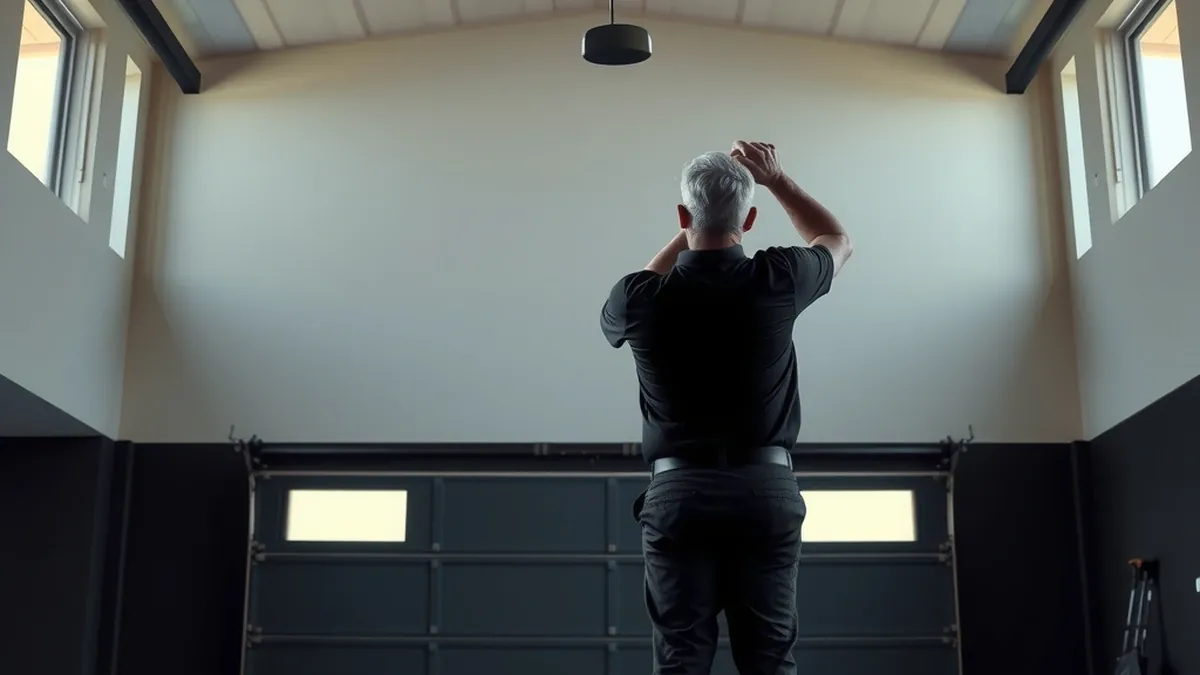
Plan for 9 ft of clearance for a driver, 10 ft to swing without thinking about it, and 8 ft for irons only. Measure from the mat to the lowest obstruction overhead — opener rail, door track, light, or beam — not to the drywall.
- Driver minimum
- Player height + 3 ft (9 ft for a 6 ft golfer)
- Comfortable
- 10 ft, including projector and mat
- Irons only
- Player height + 2 ft (8 ft for a 6 ft golfer)
- Lowest obstruction
- Door tracks and opener rails often sit at 7 ft 6 in
- Measure to
- Bottom face of the lowest object above the ball
Some links on this page are affiliate links.If you buy through them we may earn a commission at no extra cost to you. We do not accept payment for rankings. Read the full disclosure.
Nine feet is the number most home simulator plans land on, and it is a sound one. It gives a six-foot golfer about three feet of clearance at the top of a driver swing. The catch is that nine feet of drywall rarely means nine feet of usable room. Door tracks, opener rails, lights, beams, and ducts take the first six to eighteen inches, and they usually sit exactly where the backswing needs space.
Ceiling height for a simulator is the distance from the top of the hitting mat to the lowest obstruction in the swing zone, not the slab-to-slab figure on a floor plan.
Why 9 ft is the number you keep hearing
Work the geometry. A driver is 45 to 46 inches long. At the top of the backswing the hands finish near head height, and the shaft continues up and behind the player, so the clubhead sits roughly 3 ft above the hands. For a 5 ft 10 in player that puts the clubhead near 8 ft 9 in. Add a 2 in mat and a cap, and 9 ft is the first ceiling that clears a normal adult swing without a steering correction.
That last part matters more than the number. A low ceiling rarely stops a swing outright. It makes the player shorten the backswing or come over the top to avoid a scrape, and a bay that rehearses a guarded move is worse than no bay.
Nine feet is also the most common ceiling in newer US construction and a typical clear height in a garage once the door hardware is out of the way. That overlap is why the figure circulates.
What 10 ft actually buys you
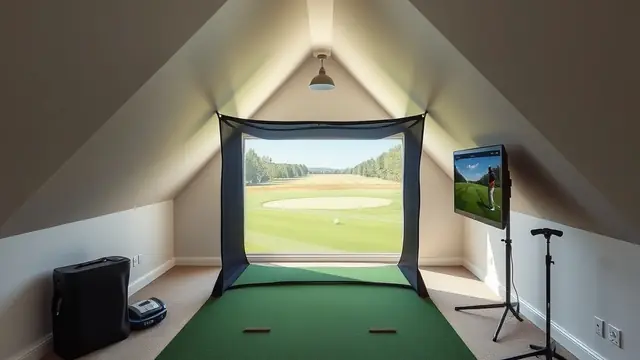
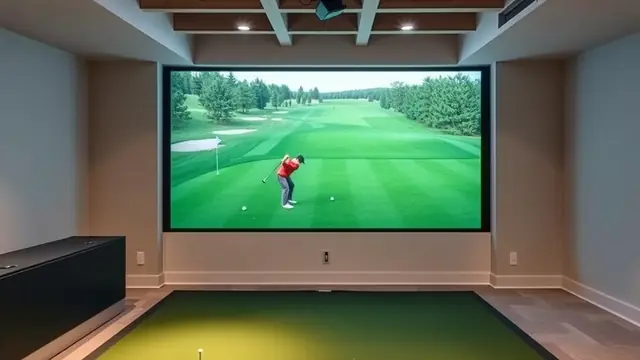
Ten feet is the difference between a bay that fits and a bay you stop thinking about. It clears a 6 ft 4 in player hitting driver, a 2 in mat, a projector hung 8 in below the ceiling, and still leaves room for a net frame or a light.
Ten feet is also the practical floor for an overhead launch monitor. Overhead units mount above the ball and carry a required mounting height in the installation manual. That height is a specification, not a preference, and a 9 ft ceiling crossed by a beam may not meet it.
Above 10 ft, extra height buys little for the swing itself. It buys enclosure height, projector placement, and the ability to hang a bay divider without ducking under it.
The clearance rule, in a table
Two numbers cover almost every case: player height plus 3 ft for a driver, plus 2 ft for irons. The difference is shaft length and the wider arc of a driver swing.
| Player height | Driver ceiling (+3 ft) | Iron ceiling (+2 ft) |
|---|---|---|
| 5 ft 4 in | 8 ft 4 in | 7 ft 4 in |
| 5 ft 6 in | 8 ft 6 in | 7 ft 6 in |
| 5 ft 8 in | 8 ft 8 in | 7 ft 8 in |
| 5 ft 10 in | 8 ft 10 in | 7 ft 10 in |
| 6 ft 0 in | 9 ft 0 in | 8 ft 0 in |
| 6 ft 2 in | 9 ft 2 in | 8 ft 2 in |
| 6 ft 4 in | 9 ft 4 in | 8 ft 4 in |
A 6 ft player needs 9 ft for driver and 8 ft for irons. If the room measures 8 ft 6 in, that player has a full iron bay and no driver. That is a legitimate practice room, but it should be a decision rather than a surprise after the screen is hung.
Measure the lowest obstruction, not the drywall
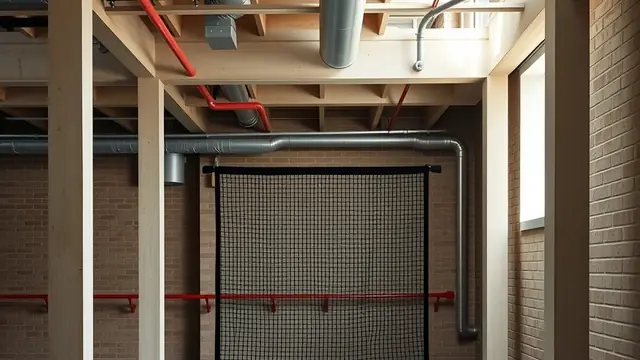
Garage door tracks and opener rails commonly sit at 7 ft 6 in, a foot or more below an 8 ft 6 in ceiling. A surface-mounted fixture can hang 6 in. A structural beam can take 12. A duct run can take 18. A ceiling-mounted projector adds 6 to 10 in of body and bracket, and it hangs behind the ball where the backswing travels.
So the useful measurement is not the ceiling height. It is the lowest thing above the ball, inside a footprint about 4 ft wide and 6 ft deep: 3 ft behind the ball and 3 ft in front of it. Take it at the ball position, too. Garage ceilings slope, and the low corner is often the corner where the bay fits.
The number to write down is clearance: floor to obstruction, minus mat thickness.
Five measurements to take before you buy
- Set the mat where it will actually live, 8 to 10 ft from the screen, and mark the ball position with tape.
- Look up and list every object within 3 ft of the ball in each direction: track, opener, light, beam, duct, projector, net frame.
- Measure from the floor to the bottom face of the lowest object, using a laser and confirming with a tape. Do not measure the drywall beside it.
- Subtract the mat thickness. A 2 in mat raises the player and the ball by 2 in and removes 2 in of clearance.
- Compare the result with your height plus 3 ft for driver and plus 2 ft for irons, then write both numbers on the tape line.
If the answer lands within 2 in of the rule, treat it as a no. Bodies move, mats compress, and guests are taller than you expect.
Low-ceiling workarounds that work
High-lift door tracks raise the horizontal track from about 7 ft 6 in to 8 ft 6 in or higher. A side-mount jackshaft opener removes the rail from the ceiling centerline entirely. Both are garage-door technician work, because the torsion spring stores enough energy to injure you.
Recessed lights or a thin surface-mount LED replace the pendant that hangs into the swing. Moving the bay to the gable end or the half of the room with the highest ceiling helps in bonus rooms, where the ridge line can add a foot. Dropping the enclosure height helps too: an 8 ft enclosure in an 8 ft 6 in room leaves 6 in for the frame and screen tension, while a 9 ft enclosure leaves none.
Hitting irons and wedges is the honest answer below 8 ft 6 in. A 3-wood buys about 2 in over a driver, not 6, so it is not a workaround. Neither is swinging easier, because the club still has to go back. Removing a beam is structural work, and the ceiling height in a listing is not a measurement.
When to call a professional
Call a licensed contractor before you cut a beam, reroute a duct, or lower a ceiling. Call a garage-door technician for track and spring work. Call an electrician for a projector circuit, a heater circuit, or any new receptacle in a garage or basement. Local code and the manufacturer’s installation manual govern all three.
The short version
Nine feet is the driver minimum for an average adult, 10 ft is comfortable, and 8 ft is an iron bay. Measure to the lowest obstruction above the ball, subtract the mat, and compare with your height plus 3 ft. If the number is close, the room is the constraint, not the launch monitor. The room dimensions guide covers width and depth next, and the garage door clearance guide covers tracks, openers, and high-lift kits in detail.
If the ceiling clears, the next decision is hardware. Compare launch monitors and budget the full build with the simulator cost guide.
Frequently asked questions
Is a 9 ft ceiling tall enough for a golf simulator?
For most adults, yes. A 9 ft ceiling clears a 6 ft player hitting driver by about 3 ft, which is the standard allowance. Taller players, steep swings, and a thick mat can eat that margin, so measure to the lowest obstruction rather than trusting the room height.
Can I use a driver with an 8 ft ceiling?
Only if you are about 5 ft tall or shorter. The driver rule is player height plus 3 ft, and an 8 ft ceiling leaves 5 ft of player. Most people use an 8 ft room for irons, wedges, and short game, which is still a useful practice bay.
Does a garage door track really lower the usable height?
Yes. A standard 7 ft door has a horizontal track and opener rail around 7 ft 6 in, which can be a foot below an 8 ft 6 in ceiling. The track usually runs several feet into the room, right through the area where the backswing needs clearance.
How much clearance does a driver need above the player's head?
About 3 ft. A driver is 45 to 46 inches long, and at the top of the backswing the clubhead sits roughly 3 ft above the hands, which finish near head height. Irons need about 2 ft because the shaft is shorter and the arc is tighter.
Should I measure ceiling height from the floor or the mat?
Measure from the finished floor and then subtract the mat thickness, or measure from the top of the mat if it is already in place. A 2 inch mat raises the player and the ball by 2 inches, so it removes 2 inches of clearance from the number you measured.
Will a ceiling-mounted projector fit in a 9 ft room?
Usually, but the projector body and bracket hang 6 to 10 inches below the drywall, and the projector sits behind the ball where the backswing travels. Check the lens height and the throw distance before you commit, because the projector can become the lowest obstruction in the room.
Sources
Some links are affiliate links.If you buy through them we may earn a commission at no extra cost to you. We do not accept payment for rankings. Read the full disclosure.