Golf Simulator Basement Low Ceiling: Room Rules and Hardware
How to fit a golf simulator in a basement with low ceiling height, including minimum dimensions, impact screen clearance, and launch monitor placement.
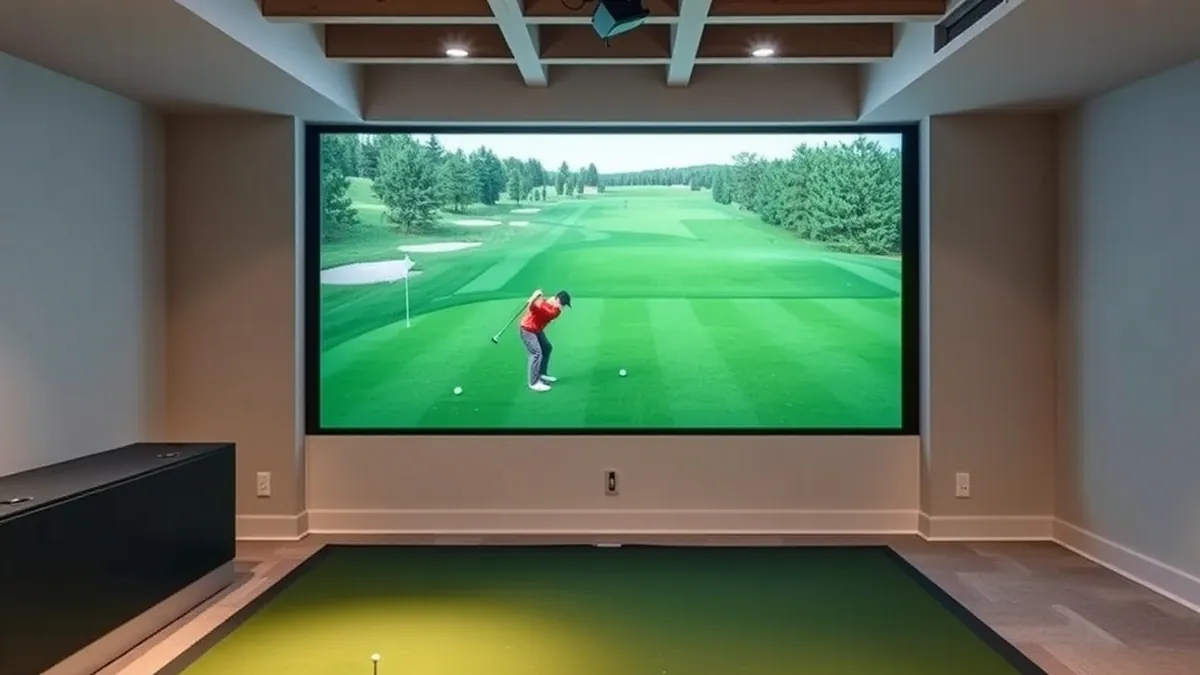
You generally need at least 8.5 to 9 feet of ceiling height for a safe golf simulator basement setup, though 10 feet is ideal for full swings without risking contact with joists or lights.
- Minimum ceiling height
- 8 ft 6 in (9 ft recommended)
- Minimum room width
- 10 ft (12 ft preferred)
- Minimum room depth
- 14 ft (16 ft preferred)
- Typical enclosure weight
- 40–80 lbs
- Estimated starting cost
- $1,500–$5,000+
Some links on this page are affiliate links.If you buy through them we may earn a commission at no extra cost to you. We do not accept payment for rankings. Read the full disclosure.
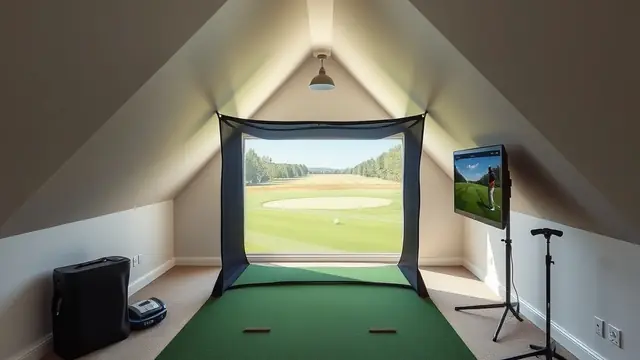
A golf simulator in a basement with a low ceiling is possible, but the room dimensions decide what you can swing and where you can stand. Most adult golfers need at least 8 feet 6 inches of clear ceiling height, and 9 to 10 feet is safer for driver swings. Before you buy a launch monitor or enclosure, measure the basement from finished floor to the lowest obstruction.
Measure the Room Before Buying Hardware
Basement ceilings often hide ductwork, beams, and joists that reduce usable height. Measure from the finished floor to the lowest point in the area where you plan to stand and swing. If you have a 7-foot-6-inch ceiling, a full driver swing is likely unsafe. If you have 8 feet 6 inches or more, you can build around the limit with shorter clubs or modified stances.
Width matters as much as height. You need enough room to address the ball without hitting a wall on your follow-through. A minimum width of 10 feet works for many setups, though 12 feet gives a right-handed golfer more margin on the left side and a left-handed golfer more margin on the right. Depth should be at least 14 feet from the hitting mat to the impact screen or net, with 16 feet preferred to separate ball flight from the screen and reduce bounceback risk.
Write down the lowest ceiling measurement, not the average. A basement with a 9-foot center and a 7-foot-6-inch beam across the middle is a 7-foot-6-inch room for simulator purposes.
Clearance Rules for Swings and Screens
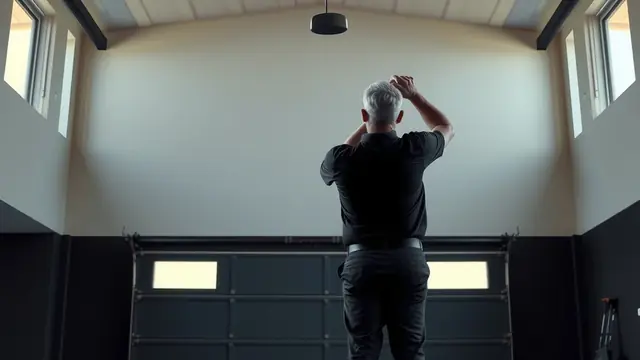
Clubhead speed creates an arc that extends above your head. A driver swing for an average male golfer can reach 9 to 10 feet high depending on height and swing plane. Subtract your height and arm reach from the ceiling measurement to estimate available clearance. If the ceiling is 8 feet 6 inches and your hands reach 7 feet at address, you have roughly 18 inches of overhead room before contact with joists or lighting.
Impact screens need their own clearance. Mount the screen at least 12 to 18 inches away from the back wall so the ball does not rebound into the wall or damage drywall. Leave at least 6 to 12 inches between the top of the screen and the ceiling if you are using an enclosure frame, because the screen can billow backward on impact.
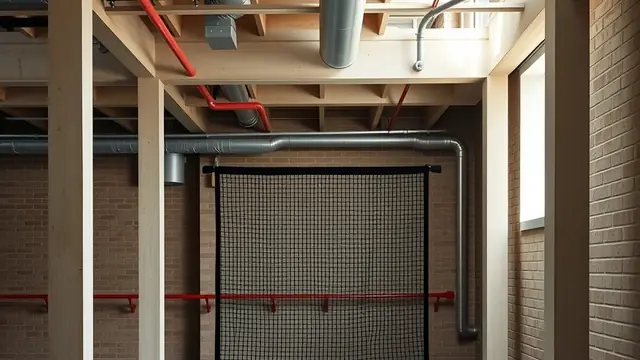
If your basement has exposed joists, consider padding them or boxing them in with lumber and drywall. A 2-by-4 joist wrapped in 1/2-inch plywood and foam padding costs roughly $15 to $30 per joist in materials, depending on lumber prices. That is an estimate; actual costs vary by supplier and region.
Flooring and Load Considerations
Basement floors are usually concrete, which is hard on clubs, wrists, and floors. A hitting mat protects both. Most residential hitting mats weigh between 40 and 80 pounds and measure 4 by 5 feet or 5 by 5 feet. Place the mat on a level surface. If the concrete slopes toward a drain, use self-leveling compound or interlocking foam tiles underneath the mat. A 24-pack of 2-by-2-foot foam tiles covering 96 square feet typically costs $100 to $200, an estimate based on common retail pricing.
Check the load if you plan to mount a heavy enclosure or screen frame to floor joists above a finished basement ceiling. A typical golf simulator enclosure with screen, frame, and side netting can weigh 40 to 80 pounds. Distributed across four anchor points, that is 10 to 20 pounds per point, well within the capacity of most residential floor joists when anchored into blocking or joists rather than drywall alone. If you are unsure, consult a structural professional before mounting heavy gear overhead.
Launch Monitor Placement in Low Rooms
Launch monitors divide into two general types: radar-based units that sit behind the ball and camera-based units that sit beside or above the hitting area. Radar units often need 8 to 16 feet of depth behind the ball to track flight, which can be difficult in a shallow basement. Camera-based units often work in tighter spaces because they capture impact data at the mat, but you should verify the specific model’s minimum room requirements before purchase.
Ceiling-mounted launch monitors save floor space but require secure overhead mounting. In a basement with joists spaced 16 inches on center, you can attach a mount to a joist using lag screws. Avoid mounting into drywall or plaster only. If the ceiling is below 8 feet, a ceiling-mounted unit may be too close to the swing path and risk contact.
For a closer look at how launch monitors compare in different room types, see the launch monitor guide at /best-launch-monitor/. If you are deciding between models for a smaller space, the Garmin R10 review at /garmin-r10-review/ covers a portable radar option that many golfers use in multi-purpose rooms.
Enclosure, Screen, and Lighting
An enclosure keeps balls inside the room and protects basement walls, windows, and utilities. A basic net and frame package starts around $500 to $1,000, while a full enclosure with impact screen, side netting, and floor padding often runs $1,500 to $3,000, depending on size and materials. These are estimates; prices vary by brand and retailer.
Mount the projector high enough to avoid the swing path but low enough to fill the screen. In a low-ceiling basement, a short-throw projector mounted behind the golfer or on a side shelf can reduce throw distance and keep the beam out of the swing arc. A 1080p projector suitable for simulator use typically costs $600 to $1,500, an estimate based on common retail models.
Lighting should be recessed or flush-mounted. Pendant lights and track fixtures are hazards in a low room. If you replace an existing light with a flush mount, turn off power at the breaker and confirm the circuit is dead before working. Electrical changes in a basement may require a permit depending on local code.
For more on enclosure options, see the enclosure overview at /golf-simulator-enclosure/. If you want cost context for a full build, the cost guide at /golf-simulator-cost/ breaks down typical price tiers.
Building Around Low Ceilings
If your ceiling is below 9 feet, adjust expectations rather than forcing a driver setup. Use the simulator for iron and wedge play, putting, and short-game practice. Many golfers in low rooms remove the driver from the bag during indoor sessions or swing only 75 percent to stay under the ceiling limit.
You can also shorten the tee height. A driver teed an inch high requires less vertical room than one teed two inches high, though it changes launch conditions. Some golfers in low rooms hit off the mat without a tee for irons, which eliminates the risk of the tee or ball striking overhead obstructions during the backswing.
If the basement has a support column in the hitting area, build the enclosure around it or move the hitting mat to one side. Do not swing around a column if the club could strike it on a mishit. Padding the column reduces injury risk but does not make a direct hit safe.
Permits, Insurance, and Resale
Finishing a basement for a simulator may trigger permit requirements if you add electrical circuits, plumbing, or structural changes. A portable mat and net usually do not require a permit, but a ceiling-mounted projector or permanent enclosure frame might. Check with your local building department before cutting into walls or ceilings.
Homeowners insurance may cover accidental damage from a golf ball, but verify your policy. Some insurers ask about indoor sports equipment, especially if you mount heavy gear to joists. If you sell the home, a simulator room can appeal to buyers, but a low-ceiling setup that requires removing a driver from the bag may be seen as a limitation rather than an amenity.
For a broader look at basement simulator planning, see the basement room guide at /golf-simulator-basement/. If you are comparing complete packages across price ranges, the best simulator guide at /best-golf-simulator/ and the under-$10,000 guide at /best-golf-simulator-under-10000/ include options that fit different room sizes.
Bottom Line
A golf simulator basement low ceiling project starts with the room, not the hardware. Measure the lowest ceiling point, confirm at least 8 feet 6 inches for safety, and allow 10 to 12 feet of width and 14 to 16 feet of depth. Pad obstructions, use flush lighting, and choose a launch monitor that fits your depth. If the ceiling is under 9 feet, plan for iron and wedge play rather than full driver swings.
Next, compare best golf simulator under 10000, best golf simulator, best launch monitor. before you commit.
Frequently asked questions
What is the minimum ceiling height for a basement golf simulator?
Most golfers need at least 8 feet 6 inches of clear ceiling height, with 9 to 10 feet preferred so a driver swing does not risk hitting joists, beams, or lights.
Can I use a garage heater in a basement simulator room?
Only if it is rated for indoor residential use and properly vented; unvented combustion heaters can create carbon monoxide risks in enclosed basement spaces.
Do I need a building permit for a basement simulator?
It depends on your municipality; electrical work, framing, or egress changes often require permits, while placing a portable enclosure usually does not.
How much does a low-ceiling basement simulator cost?
A basic hitting mat, net, and launch monitor can start around $1,500, while a full enclosure with projector and screen often runs $3,000 to $7,000 or more.
Can I swing a driver in an 8-foot ceiling basement?
It is risky for most adult golfers; an 8-foot ceiling leaves little margin for error and increases the chance of club or ball contact with overhead obstructions.
What launch monitor works best in a narrow basement?
Radar-based units need more depth behind the ball, while camera or photometric units often fit tighter rooms, though you should verify the specific model's minimum space requirements.
Sources
Some links are affiliate links.If you buy through them we may earn a commission at no extra cost to you. We do not accept payment for rankings. Read the full disclosure.