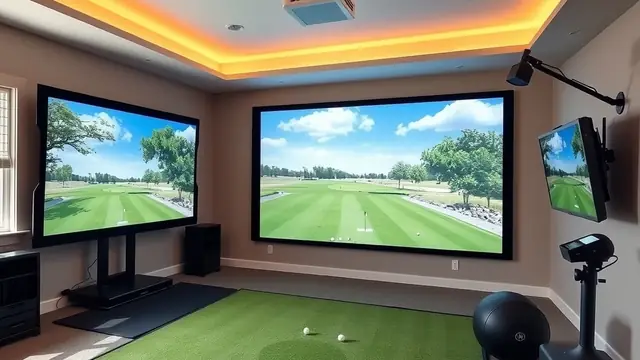
Best golf simulators for a home bay
Five home simulator builds, from a $4,000 turnkey enclosure to a $14,000 ceiling-mounted TrackMan, sorted by room size and budget.
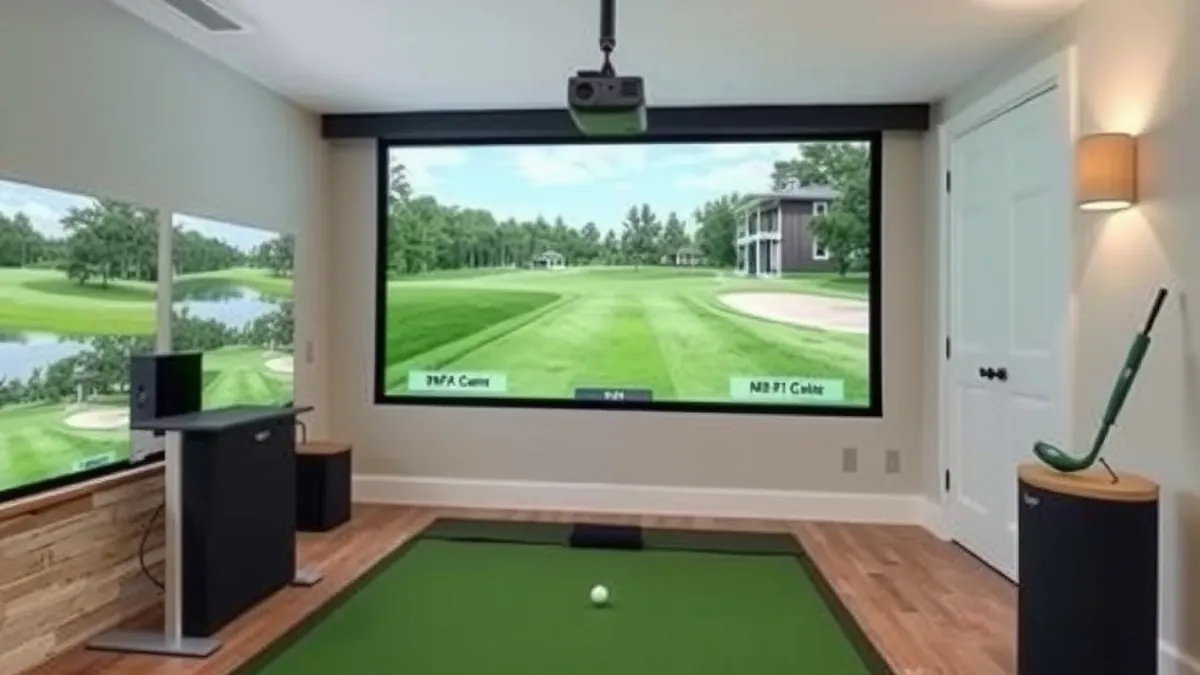
For most home bays, the SkyTrak ST MAX Studio is the best complete system from $4,195: camera-and-radar tracking, enclosure, screen, projector, and mat in one order. For the lowest turnkey enclosure price, the Garmin R10 SwingBay starts at $3,998.99.
- Best overall
- SkyTrak ST MAX Studio, from $4,195
- Best under $5,000
- Garmin R10 SwingBay, from $3,998.99
- Best premium
- TrackMan iO, from $13,995
- Best small room
- Foresight GC3, from $3,999
- Best for a garage
- Bushnell Launch Pro SIG8, from $4,899.99
Some links on this page are affiliate links.If you buy through them we may earn a commission at no extra cost to you. We do not accept payment for rankings. Read the full disclosure.
A complete golf simulator is a system, not a monitor. The sensor gets the reviews, but the enclosure, screen, projector, mat, and computer decide whether the bay is usable every week.
A home simulator system bundles a launch monitor with the hardware and software that turn ball flight into a projected course. The monitor sets the room requirements; the package sets the real price.
What a complete system has to include
Five purchases decide the result.
- Room fit. Depth is the binding constraint. Camera units need about 8 ft from ball to screen. Radar units want 8 to 10 ft of flight and another 6 to 8 ft behind the ball for the unit. The room dimensions guide walks through the envelope.
- Monitor accuracy. Cameras measure the ball directly in the first inches after impact. Radar watches flight, which is an advantage outdoors and a liability in a short room.
- Software. The monitor’s own app is enough for a range session. Full course play usually means a subscription, and third-party software means a Windows PC.
- Projector and screen. A 10 to 12 ft image needs roughly 3,000 to 5,000 lumens in controlled light. Short-throw models matter when the projector sits close to the screen.
- Total cost. Add the PC, the first year of software, the mat upgrade, padding, and electrical work. Those items routinely add 20 to 35 percent.
The five picks at a glance
| System | Best for | Tracking | Footprint | From |
|---|---|---|---|---|
| SkyTrak ST MAX Studio | Most home rooms | Camera + dual radar | 8 ft W studio | $4,195 |
| Garmin R10 SwingBay | Turnkey under $5,000 | Radar | 11 ft W × 15 ft D | $3,998.99 |
| TrackMan iO | Premium fixed install | Radar + infrared + imaging | 8 ft 2 in ball to screen | $13,995 |
| Foresight GC3 | Small rooms | Triscopic cameras | 6 × 5 × 12 in unit | $3,999 |
| Bushnell Launch Pro SIG8 | Garages | Three cameras + infrared | 8 ft 4 in W enclosure | $4,899.99 |
Prices are the lowest advertised configuration in November 2026 and may change.
Best overall: SkyTrak ST MAX Studio
The ST MAX Studio is the pick because it solves the whole problem in one order. The monitor combines a photometric camera for ball data with dual Doppler radar for club data, and SkyTrak publishes 21 data points without requiring stickers on the club or ball.
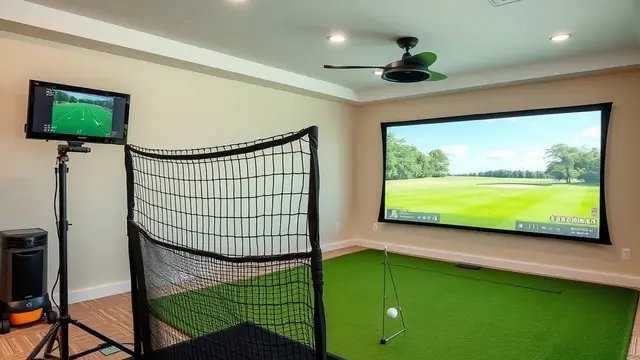
The Standard Studio includes the enclosure, impact screen, frame, 5 × 5 ft mat, and a short-throw projector. The 8 ft version measures 8 ft wide, 7 ft 5 in high, and 4 ft deep, which makes it the most room-friendly package here. It also floor-mounts the projector, so you do not need a ceiling mount.
Two costs sit outside the $4,195: a PC and a membership after the 14-day trial. Essential is $99.99 a year; course play runs from $299.99 to $599.99. With a $700 PC, the total lands near $5,000, which is why this is the best overall rather than the best premium.
Best under $5,000: Garmin R10 SwingBay
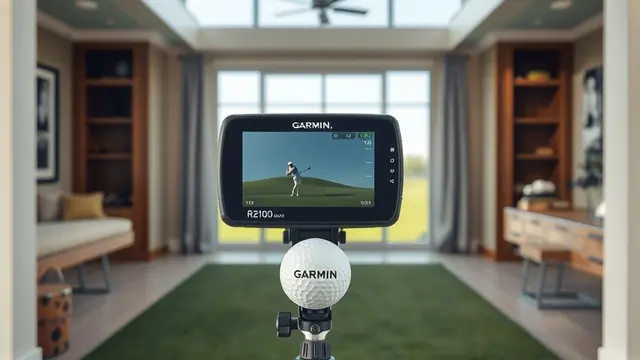
The R10 SwingBay is the cheapest way to get a real enclosure, screen, projector, and launch monitor from one vendor. The package starts at $3,998.99 and includes the SwingBay enclosure, SwingTurf mat, short-throw projector, ceiling mount, 25 ft HDMI cable, and the Garmin R10.
The trade-off is radar: the R10 needs 6 to 8 ft behind the ball and 8 ft of flight, so the package footprint is 11 ft wide by 15 ft deep by 8.1 ft high. In a garage, metal door tracks and large metal objects near the radar path can cause interference. Spin rate is calculated from club data, not measured directly.
For a golfer with the depth and a tight budget, that is a fair trade. Add a $700 to $1,000 gaming PC and the total is roughly $4,700 to $5,000, with a free first-year GSPro license included at the time of writing.
Best premium: TrackMan iO
The iO is the premium answer because it removes the monitor from the floor. The unit mounts to the ceiling and combines radar, infrared, and high-speed imaging to produce measured 3D spin and spin axis. Nothing sits behind the golfer, which frees up depth and protects the unit.
TrackMan lists the iO from $13,995. That is hardware, not a finished room. TrackMan’s own space guidance asks for a 10 ft ceiling, 15 ft of width, and 18 ft of depth, with the screen about 8 ft 2 in from the ball. Enclosure, projector, computer, installation, and the annual software subscription are separate.
This is the pick for a dedicated room where the bay is part of the architecture, not a net in a spare garage. The accuracy and software depth are the reason to spend; the installation is the reason to plan it early.
Best small room: Foresight GC3 (monitor-led build)
The GC3 is a 6 × 5 × 12 in, 5 lb camera unit that sits beside the ball; it is a monitor, not a complete enclosure package. Three cameras measure ball and club data, and the package includes club markers, a sling bag, and a two-year warranty. Foresight currently advertises it from $3,999, down from a $6,999 list price.
Because it measures impact rather than flight, it is the most forgiving choice for a room that cannot spare 16 ft of depth. Foresight’s setup guidance still wants about 8 ft from ball to screen, but the unit itself does not need space behind the golfer.
The hidden cost is the rest of the bay. At $3,999 you have a monitor and no enclosure, projector, screen, or PC. A realistic 10 ft DIY build adds $2,500 to $3,500, which puts a complete GC3 bay near $7,000.
Best for a garage: Bushnell Launch Pro SIG8
The Launch Pro uses the same three-camera, infrared measurement approach as the GC3 in a Bushnell body. Ball data works out of the box; club data needs the Silver ($199 a year) or Gold ($599 a year) software tier. The SIG8 package at $4,899.99 pairs it with an 8 ft 4 in wide enclosure that fits a typical two-car garage bay.
The SIG8 is 13 ft 7 in deep, so the car comes out and the bay stays. The camera sits beside the mat, which means no radar path behind the golfer and no interference from the garage door.
The catch is software. GSPro requires the Gold tier plus its own $250 annual subscription, so price three years before you commit.
Where the budget actually goes
The monitor is usually 35 to 55 percent of a full custom room. The rest is room hardware: enclosure and screen ($800 to $2,500), projector ($600 to $2,500), mat ($300 to $1,200), PC ($700 to $1,500), and installation if you use it.
That is why two packages with the same monitor can differ by $3,000. The golf simulator cost breakdown shows the full arithmetic, and the launch monitor guide explains where the sensor money is best spent.
The short version
Buy the ST MAX Studio if you want one order, a compact footprint, and a monitor that measures both ball and club. Buy the R10 SwingBay if $5,000 is a hard ceiling and your room has 15 ft of depth. Buy the GC3 if the room is short and camera accuracy is the priority. Buy the Launch Pro SIG8 if the bay is going in a garage. Buy the TrackMan iO only when the room is permanent and the budget is already five figures.
Our top picks
- + Camera and dual-radar tracking
- + Enclosure, screen, projector, and mat included
- + Compact 8 ft studio footprint
- − PC not included
- − Course play needs a membership after the trial
- − 8 ft studio has a 7 ft 5 in enclosure height
- + Complete SwingBay enclosure and projector
- + R10 works indoors and at the range
- + GSPro first-year license included
- − Needs 14 ft of total depth
- − Spin rate is calculated, not measured
- − PC required for PC-based software
- + Ceiling-mounted, nothing behind the golfer
- + Radar, infrared, and high-speed imaging
- + Measured 3D spin and spin axis
- − Hardware only at the starting price
- − Professional installation expected
- − Software subscription is extra
- + Triscopic camera system
- + Ball and club data included
- + Two-year warranty
- − Enclosure and projector sold separately
- − Club data needs club markers
- − Needs a PC for simulation
- + Three-camera photometric unit
- + SIG8 enclosure fits an 8 ft 4 in width
- + Ball data works without a subscription
- − Club data needs Silver or Gold
- − GSPro needs the Gold tier
- − Enclosure is 13 ft 7 in deep
Frequently asked questions
What is the minimum room size for a home golf simulator?
A workable bay is about 10 ft wide by 14 ft deep by 9 ft high. A comfortable one is 12 ft wide by 16 to 18 ft deep by 10 ft high. Camera monitors can work with 8 ft from ball to screen; radar monitors usually want 8 to 10 ft of flight plus 6 to 8 ft behind the ball.
Is a complete simulator package cheaper than buying parts separately?
Usually yes, by 10 to 20 percent, because the dealer bundles the enclosure, screen, projector, and mat at one margin. The catch is that package projectors and mats are often the entry models. Price the package, then price the same list with the projector and mat you actually want.
Do I need a gaming PC for a golf simulator?
Only if you want PC-based software such as GSPro, E6, or FSX Play. The Garmin Golf app and SkyTrak app can run course play from a phone or tablet. A Windows PC with a dedicated graphics card is the usual requirement for third-party simulation.
How much does a golf simulator cost after the package price?
Budget another $700 to $1,500 for a PC if the package does not include one, $100 to $600 a year for software, and $300 to $1,500 for room work such as padding, lighting, electrical, and a hitting mat upgrade. Installation is separate if you hire it out.
Can a golf simulator go in a garage with a low ceiling?
Yes, but measure the lowest obstruction, not the ceiling. Garage door tracks and opener rails often sit at 7 ft 6 in. A camera unit beside the ball is the usual choice because it does not need depth behind the golfer, and a floor-mounted projector avoids a ceiling mount.
How accurate is a home simulator compared with a commercial one?
A camera-based unit that measures the ball in the first few inches after impact can be very close indoors. Radar units lose information when the room cuts flight short, so carry and spin depend more on the model. For practice, the repeatability of the unit matters more than matching a tour system exactly.
Sources
Some links are affiliate links.If you buy through them we may earn a commission at no extra cost to you. We do not accept payment for rankings. Read the full disclosure.