
Reviews guides
Format reviews and buyer guides, with the specs that matter.
Before You Buy: The Space and Budget Decisions
A golf simulator bay is a fixed room, not a portable gadget. Before comparing launch monitors, confirm the room fits the ball flight. Our standard planning numbers are a 9 ft minimum ceiling and 10 ft for comfortable driver swings, a bay width of 10 to 12 ft, and a total depth of 14 to 18 ft. That depth splits into an impact screen 8 to 10 ft from the ball and a monitor 6 to 8 ft behind the ball. Projector brightness should land between 3000 and 5000 lumens; anything dimmer washes out in a typical basement, and anything brighter usually costs more without improving image quality at a 100-inch screen size.
The first trade-off is budget versus completeness. A sub-$5,000 build forces trade-offs on the enclosure and PC, while a $10,000 build can absorb 4K projection and premium software. The second trade-off is accuracy versus space. Radar units need depth; camera units need ceiling height and lighting control. If your room sits at the low end of those ranges, you are choosing which compromise to accept, not which product is objectively best.
Complete-Build Reviews: What the Numbers Actually Mean
We review complete builds, not individual boxes in isolation. A $499.99 launch monitor looks cheap until you add an enclosure, screen, mat, PC, and mounting hardware. A $14,000 ceiling-mounted TrackMan includes the room integration; a $4,000 turnkey enclosure does not always include a computer capable of running the software at 60 fps. Line-item costs matter because a $500 saving on the monitor can become a $1,200 mistake if the PC cannot render the course graphics.
| Build tier | Typical budget | What is included | Where buyers usually cut |
|---|---|---|---|
| Entry complete build | Under $5,000 | Monitor, enclosure, projector, mat, PC | Projector lumens, PC graphics card |
| Mid-tier complete build | Under $10,000 | SkyTrak, Bushnell, or Foresight hardware; enclosure; 4K projection; software | Screen size, premium software subscription |
| Home bay builds | $4,000 to $14,000 | Turnkey enclosure to ceiling-mounted TrackMan, sorted by room size | Installation labor, ceiling reinforcement |
Our build reviews list real line-item costs so you can see where the money goes. We also state where not to cut: the screen material and the PC. A low-grade screen creates hot spots and reduces projector life, while an underpowered PC turns a $10,000 simulator into a slideshow.
What We Do Not Test
We do not test outdoor driving ranges, golf clubs, apparel, or golf travel. Our scope is indoor simulator hardware and complete bays only. We do not review launch monitors that require permanent outdoor installation, and we do not score simulator software by course count alone. A library of 100 courses means little if the frame rate drops below 30 fps on a mid-range PC.
We also do not accept manufacturer review units for scorekeeping. Every specification cited here comes from published technical documentation, and every build cost reflects retail pricing at time of publication. If a product does not fit a 9-to-10 ft ceiling or a 14-to-18 ft depth, we say so rather than forcing it into a buyer’s guide.
FAQ
What ceiling height do I need?
A 9 ft ceiling is the minimum; 10 ft is comfortable for driver swings without restricting your follow-through.
How far should the screen be from the ball?
Position the impact screen 8 to 10 ft from the ball, with the monitor 6 to 8 ft behind the ball.
Which article should I read first?
Start with our home bay builds if you are matching a room to a budget, or read the Garmin R10 review if you need a radar under $500.
If you are deciding between a budget radar and a camera-based monitor, the SkyTrak+ review covers camera and radar tracking, room requirements, and membership costs. For mid-tier spending, our comparison of builds under $10,000 breaks down SkyTrak, Bushnell, and Foresight hardware with line-item costs. For the strictest budget, see our complete builds under $5,000, including where to cut and where not to.
All reviews guides
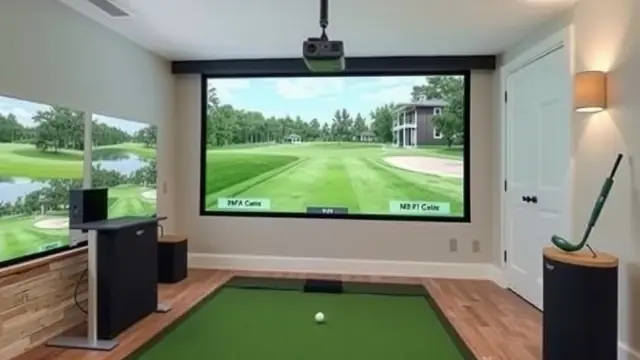
Best golf simulators for a home bay
Five home simulator builds, from a $4,000 turnkey enclosure to a $14,000 ceiling-mounted TrackMan, sorted by room size and budget.
Read the guide →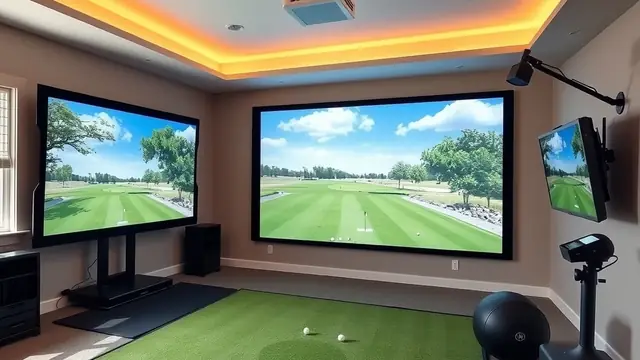
Golf Simulator Builds Under $10,000, Compared
Four mid-tier simulator builds under $10,000, with line-item costs for SkyTrak, Bushnell, and Foresight hardware, enclosures, 4K projection, and software.
Read the guide →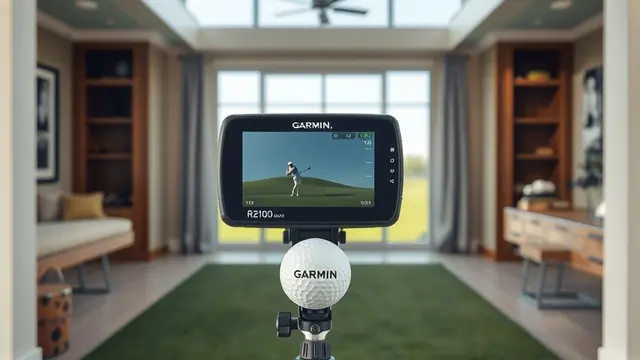
Garmin R10 review: the budget radar
A specification review of the Garmin Approach R10: radar tracking, 14 metrics, indoor space, accuracy limits, subscriptions, and who the $499.99 unit suits.
Read the guide →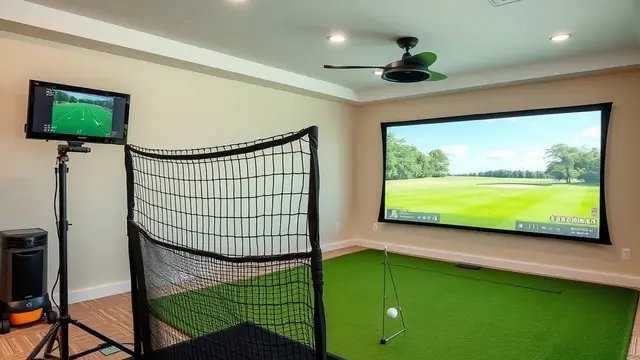
Best golf simulator under $5,000
Four complete builds under $5,000, with real line-item costs for the monitor, enclosure, projector, mat, and PC, plus where to cut and where not to.
Read the guide →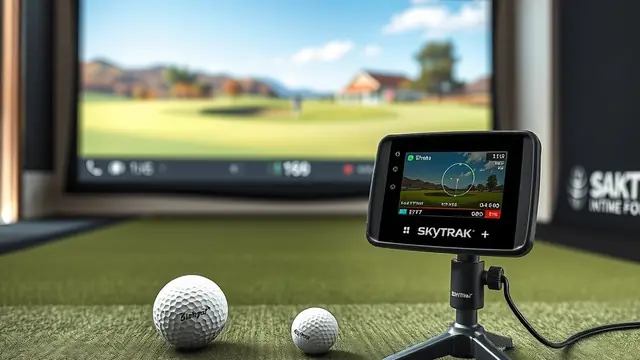
SkyTrak+ review: specs, space, subscription
A specification review of the SkyTrak+ launch monitor: camera and radar tracking, 21 data points, room requirements, memberships, software, and who it suits.
Read the guide →