SkyTrak+ review: specs, space, subscription
A specification review of the SkyTrak+ launch monitor: camera and radar tracking, 21 data points, room requirements, memberships, software, and who it suits.
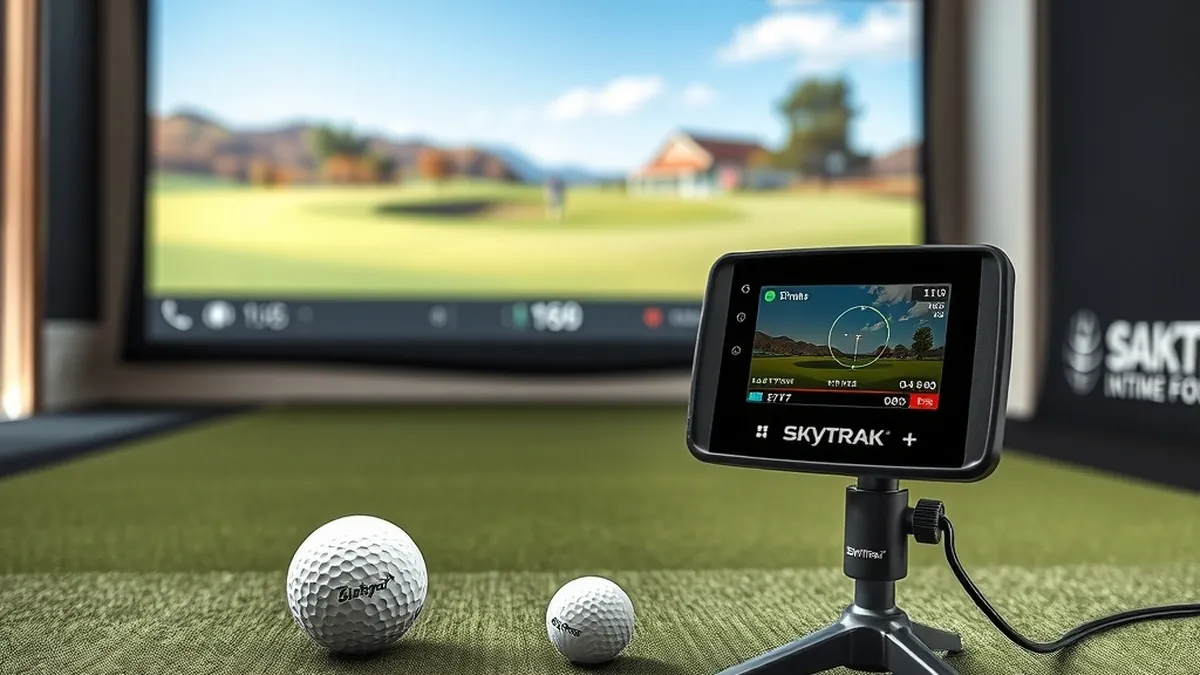
The SkyTrak+ combines a photometric camera with dual Doppler radar and publishes 21 data points, with no stickers on the club or ball. It needs about 8 ft from ball to screen and is now discontinued, so it is worth buying only at the $1,995 closeout price.
- Tracking
- Photometric camera plus dual Doppler radar
- Data points
- 21 published by SkyTrak
- Ball to screen
- About 8 ft
- Price
- From $1,995 closeout; $2,995 list
- Status
- Discontinued, replaced by the ST MAX
Some links on this page are affiliate links.If you buy through them we may earn a commission at no extra cost to you. We do not accept payment for rankings. Read the full disclosure.
The SkyTrak+ is a compact launch monitor that pairs a photometric camera with dual Doppler radar. It measures the ball at impact, adds club data from radar, and fits a room that a rear-mounted radar unit cannot.
This is a specification review, not a hands-on test. The numbers come from SkyTrak’s documentation; the judgment is about fit and price.
What the SkyTrak+ is
The SkyTrak+ launched in 2023 as the successor to the original SkyTrak. It sits on the mat beside the ball, roughly 8 ft from the impact screen, and sends data to the SkyTrak app on a phone, tablet, or PC.
Its two sensor systems do different jobs. The camera photographs the ball immediately after impact and derives launch, speed, and spin. The dual Doppler radar watches the club through the hitting zone and derives clubhead speed, path, face angle, and smash factor. SkyTrak says the radar is within 1.5 degrees of TrackMan for club data and the camera is within 2 yards for ball data, based on third-party testing it cites.
The unit is now discontinued. SkyTrak lists the ST+ as no longer available and sells the ST MAX as its replacement. Any remaining ST+ stock sits with third-party retailers, which is the only reason the price is interesting.
Specs that matter
| Specification | SkyTrak+ |
|---|---|
| Technology | Photometric camera plus dual Doppler radar |
| Data points | 21 published by SkyTrak |
| Ball metrics | Carry, total, ball speed, launch angle, side angle, back spin, side spin, descent angle, shot shape |
| Club metrics | Clubhead speed, smash factor, club path, face angle, face-to-path |
| Indoor/outdoor | Both |
| Ball marking | Not required |
| Club marking | Not required |
| Ball to screen | About 8 ft |
| Price | From $1,995 closeout; $2,995 list |
SkyTrak publishes 21 points; the list above covers the named ball and club metrics. For practice, the important columns are club path, face angle, and spin, because those explain a curve rather than describe it.
The omission worth knowing is angle of attack. If attack angle is central to your swing work, the Bushnell Launch Pro or a Foresight unit is a better fit.
Space: 8 ft to the screen
SkyTrak’s setup guidance puts the unit about 8 ft from the impact screen. That is the distance at which the camera has enough flight to read the ball and the radar has enough room to resolve the club.
Because the unit sits beside the ball, the room does not need 6 to 8 ft behind the golfer for a radar path. You still need 3 to 4 ft behind the player for the backswing. A 10 ft wide by 12 ft deep room works; 12 ft wide by 14 ft deep is comfortable.
Ceiling height is separate. A driver needs about 3 ft of clearance above the player’s height, and irons need about 2 ft. A 9 ft ceiling is the usual minimum for a full swing; 10 ft is safer. The room dimensions guide has the full envelope.
The 21 data points
The ball data is the strong part. Carry, total, ball speed, launch angle, side angle, back spin, side spin, descent angle, and shot shape give you enough to diagnose a ball flight without a launch monitor operator’s manual.
The club data is useful but narrower. Clubhead speed, smash factor, club path, face angle, and face-to-path cover the common swing faults. There is no attack angle, and no measurement of dynamic loft or lie. For a player working on path and face, that is enough. For a coach building a full club-fitting profile, it is not.
The app adds a shot optimizer that compares your numbers with optimal launch conditions, plus bag mapping, wedge matrix, and a skills assessment. Those tools are the reason to buy the SkyTrak ecosystem rather than a bare launch monitor.
Subscription and software
A free tier covers basic range data. The paid plans are where the value sits:
- Essential, $99.99 a year. Driving range, practice library, challenges, and game evaluation.
- Core Foresight, $299.99 a year. Adds 51 Foresight courses, including Pebble Beach and Muirfield Village.
- Core TrackMan, $349.99 a year. Adds 53 TrackMan courses, including Bethpage Black and Royal Portrush.
- Elite, $599.99 a year. Adds both libraries, more than 100 courses, and shop discounts.
The course libraries are the main reason to upgrade. If you only want range data, the free tier and Essential are enough. If you want league nights, Elite is the cheaper path to both libraries, but it is still $599.99 every year.
Third-party software is possible, but it is not a way to avoid the subscription entirely. Check the current compatibility list for GSPro or E6 before you assume the unit will connect the way you want.
Indoor and outdoor use
SkyTrak rates the ST+ for indoor and outdoor use. The camera system is designed to work on range mats, and the unit is portable enough to move between the garage and the car.
Direct sunlight and a bright background are still hard on a camera, so a shaded range bay is better than an open field.
Indoors is where it makes most sense: the short screen distance is the reason to choose it over radar, and the camera ignores the metal garage doors that trouble radar.
Pros and cons
Pros
- Camera and radar in one compact unit.
- No stickers on the ball or club.
- About 8 ft from ball to screen, which fits a short room.
- 21 data points, including path and face angle.
- Strong closeout price while stock lasts.
Cons
- Discontinued, with no new stock from SkyTrak.
- No angle of attack in the club data.
- Course play needs a $299.99 to $599.99 annual plan.
- Owner reports put battery life at 2 to 3 hours.
- The small hitting area rewards a consistent ball position.
Who it suits
The ST+ suits a golfer with a room about 12 ft deep who wants camera accuracy and club-path data without a ceiling mount. It also suits a player who splits practice between a garage bay and an outdoor range, because the unit moves easily and does not need a radar path behind the ball.
It does not suit a golfer who wants the newest model, a full fitting data set, or course play without another annual bill.
The short version
The SkyTrak+ is a good launch monitor at a great closeout price and a questionable one at list price. At $1,995 it is the cheapest way to get camera ball tracking plus radar club data from a major brand. At $2,995 it competes with the ST MAX, which is current, in stock, and carries the same basic approach.
| Question | Verdict |
|---|---|
| Buy at $1,995? | Yes, if stock and warranty check out |
| Buy at $2,995? | No, choose the ST MAX instead |
| Best room depth? | 11 to 12 ft |
| Best use? | Practice and compact camera bays |
| Skip if? | You need attack angle or a current model |
If you are choosing between the two budget entry points, the SkyTrak vs Garmin R10 comparison reduces the decision to room depth and sensor type. If you are still shortlisting monitors, the launch monitor guide explains what each class measures. And if you are pricing the whole bay, the simulator cost breakdown shows where the monitor sits in the total.
Frequently asked questions
Is the SkyTrak+ still worth buying in 2026?
At the closeout price of $1,995, yes, if you want a compact camera unit and do not need the newest model. At the original $2,995 list price, the SkyTrak ST MAX is the better buy because it is the current product with the same camera-and-radar approach. Check stock and warranty before you order.
How much space does a SkyTrak+ need?
Plan on about 8 ft from the ball to the impact screen, plus 3 to 4 ft behind the player for the backswing. The unit sits beside the ball, so it does not need the 6 to 8 ft of rear clearance that a radar unit requires. A 10 ft wide by 12 ft deep room is a workable minimum.
Does the SkyTrak+ measure spin directly?
Yes. The photometric camera reads the ball in the first inches after impact and reports back spin, side spin, and shot shape. That is the main advantage over a radar unit in a short room, where the flight is cut off before the radar can watch the whole trajectory.
Do I need a subscription to use the SkyTrak+?
A free tier covers basic range data. The Essential plan is $99.99 a year, Core Foresight is $299.99, Core TrackMan is $349.99, and Elite is $599.99. Course play and the full practice library sit in the paid tiers, so price the first year with the hardware.
Does the SkyTrak+ work outdoors?
SkyTrak rates it for indoor and outdoor use, and the camera system is designed to work on range mats. Bright direct sunlight and a moving ball can still challenge a camera unit, so a shaded range bay is better than an open field. It is not a replacement for a dedicated outdoor radar unit.
What software works with the SkyTrak+?
The SkyTrak app is the native environment for range data, challenges, and course play. Third-party simulation is possible, but it depends on the membership tier and on a separate software subscription. Check compatibility with the specific platform before you buy, because the list changes.
Sources
Some links are affiliate links.If you buy through them we may earn a commission at no extra cost to you. We do not accept payment for rankings. Read the full disclosure.