Garmin R10 review: the budget radar
A specification review of the Garmin Approach R10: radar tracking, 14 metrics, indoor space, accuracy limits, subscriptions, and who the $499.99 unit suits.
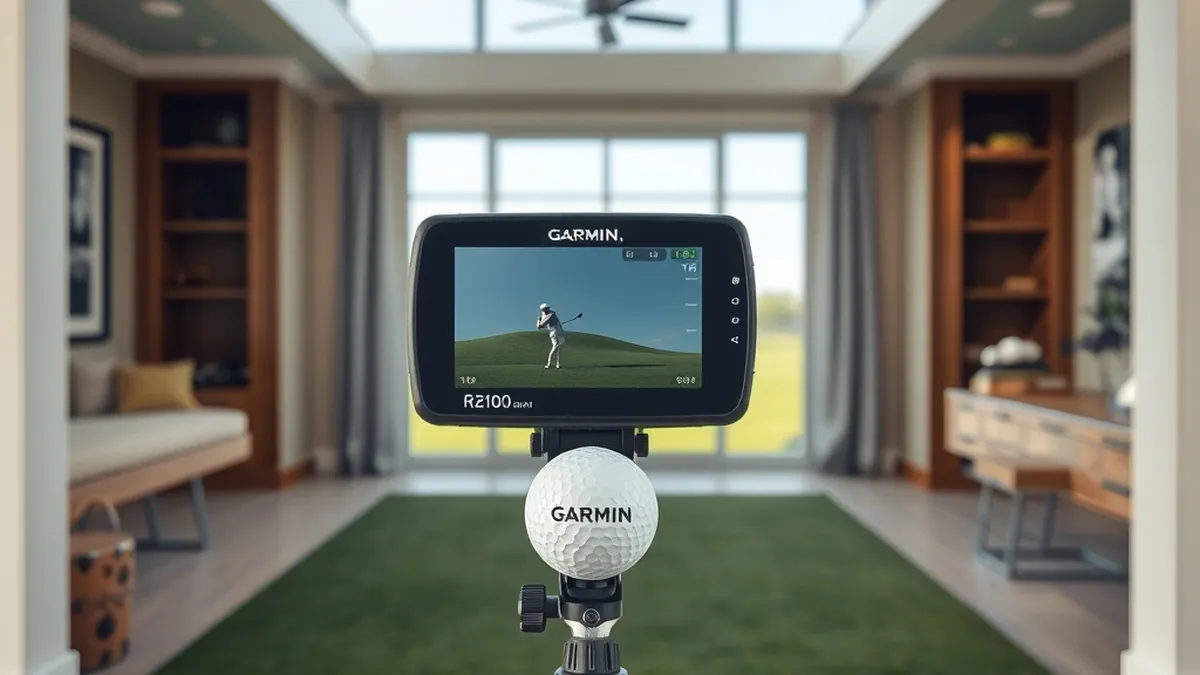
The Garmin Approach R10 is a $499.99 radar launch monitor that tracks 14 metrics and needs 6 to 8 ft behind the ball plus 8 ft of flight. It is the cheapest usable indoor radar unit, but spin is calculated and a short room exposes its limits.
- Price
- From $499.99
- Tracking
- Doppler radar
- Metrics
- 14 per shot
- Placement
- 6 to 8 ft behind the ball
- Total depth
- About 14 ft
Some links on this page are affiliate links.If you buy through them we may earn a commission at no extra cost to you. We do not accept payment for rankings. Read the full disclosure.
The Garmin Approach R10 is the least expensive launch monitor that still does a useful job indoors. It is a $499.99 radar unit, and the room it needs is the main thing to understand before you buy it.
This is a specification review, not a hands-on test. The figures come from Garmin’s product and support documentation; the judgment is about room fit, data quality, and the software stack.
What the R10 is
The R10 is a small radar unit that sits on a tripod 6 to 8 ft behind the ball. It tracks the club and ball through flight, then sends 14 metrics to the Garmin Golf app on a phone or tablet.
It weighs 7.79 oz, runs up to 10 hours on a charge, and costs $499.99. That is roughly one-sixth of a SkyTrak+ and one-tenth of a TrackMan iO. The price gap is not a mystery: radar needs flight, and a home bay does not always have enough of it.
The R10 also works outdoors, where it can watch the whole trajectory. That makes it a better dual-use purchase than a camera unit that stays in the garage.
Specs that matter
| Specification | Garmin Approach R10 |
|---|---|
| Technology | Doppler radar |
| Metrics | 14 per shot |
| Placement | 6 to 8 ft behind the ball |
| Ball to screen | 8 ft minimum |
| Total depth | About 14 ft |
| Battery | Up to 10 hours |
| Weight | 7.79 oz |
| Price | From $499.99 |
| Course play | Home Tee Hero, paid membership |
The 14 metrics cover ball speed, launch angle, launch direction, spin axis, spin rate, apex height, smash factor, carry, total distance, deviation, clubhead speed, club face angle, club path, and angle of attack. That is a complete practice set on paper.
The important caveat is how those numbers are produced. Garmin measures ball speed and launch with radar. Spin rate is calculated from club and ball data, not measured directly. Club face angle is also calculated. The result is useful for practice, but it is not the same as a camera reading the ball at impact.
Space: 14 ft of total depth
Garmin’s placement guidance is 6 to 8 ft behind the ball. Add at least 8 ft of flight to the screen, and the working minimum is 14 ft. A 16 to 18 ft room is more comfortable and produces better tracking.
That number is the whole decision. A 12 ft deep spare room cannot use the R10 properly, no matter how good the price is. A 16 ft garage can. Measure to the lowest obstruction, not the ceiling, because garage door tracks and opener rails often sit at 7 ft 6 in.
The R10 also needs a clear radar path. Metal garage doors, metal shelving, and ceiling fans near the line of sight can cause interference. If the bay shares space with storage, keep the area behind the ball clear. The room dimensions guide covers the rest of the envelope.
Data and accuracy caveats
Garmin publishes accuracy figures for the R10: clubhead speed within plus or minus 3 mph, launch angle within plus or minus 1 degree, and calculated club face angle within plus or minus 2 degrees. Those are manufacturer figures, not independent test results.
The practical caveat is indoor flight. Radar learns from the ball in flight. When the screen is 8 ft away, the unit sees a short segment and models the rest. Carry distance and spin become estimates that depend on the model, the lighting, and the setup. In a longer room, the same unit has more data and produces more reliable numbers.
The second caveat is spin. Because spin is calculated, the R10 is not the right tool for club fitting or for a player trying to match a specific spin window. It is a good tool for swing path, face angle, launch, and carry trends.
The third caveat is setup. The R10 must be level with the hitting surface, aligned to the target line, and at the correct distance behind the ball. A unit that is 2 ft too close or sitting on a slope will produce numbers that look plausible and are wrong.
Subscription and software
The Garmin Golf app is free and covers range data, session history, and video. Home Tee Hero, Garmin’s course-play environment, needs a paid Garmin Golf membership, listed at $99.99 a year at the time of writing. It includes more than 43,000 courses.
Third-party software is where the R10 gets interesting. GSPro ($250 a year), E6 Connect, Awesome Golf, and Creative Golf all support the unit. A Windows PC is required for the PC-based options; the phone app bridges the data to the PC over the local network.
That makes the R10 a cheap sensor with an expensive software habit. A first-year stack of Garmin membership, GSPro, and a budget PC can add $1,000 to the $499.99 monitor. The golf simulator cost breakdown shows how those line items compare with the rest of the bay.
Pros and cons
Pros
- Lowest entry price of any usable radar unit.
- Portable and battery-powered for range sessions.
- 14 metrics, including path and face angle.
- Works with GSPro, E6, Awesome Golf, and Creative Golf.
- More useful outdoors than a camera unit at the same price.
Cons
- Needs about 14 ft of total room depth.
- Spin rate is calculated, not measured.
- Club face angle is calculated within about 2 degrees.
- Metal objects and garage doors can cause interference.
- Course play needs a separate membership.
Who it suits
The R10 suits a golfer with a 16 ft deep garage or basement who wants a first launch monitor for under $1,000. It also suits a player who wants one device for the home bay and the driving range, because the radar works outdoors and the unit fits in a golf bag.
It does not suit a shallow room, a club fitter who needs measured spin, or a player who wants a current camera unit with no setup fuss. Those buyers should look at the SkyTrak+ or the Bushnell Launch Pro.
The short version
The R10 is the best budget launch monitor in the category, with one condition: the room has to be deep enough. At 14 ft or more, it delivers a surprising amount of data for $499.99. At 10 ft, it is the wrong tool and no amount of software fixes that.
| Question | Verdict |
|---|---|
| Buy at $499.99? | Yes, if the room is 14 ft deep |
| Best room depth? | 16 to 18 ft |
| Best use? | Practice, range work, budget sim |
| Skip if? | The room is under 12 ft deep |
| Upgrade path? | Camera unit for short rooms |
If you are deciding between the two entry points, the SkyTrak vs Garmin R10 comparison narrows it to room depth and sensor type. If you want the wider shortlist, the launch monitor guide covers the next price tiers. And if you are building the whole bay around the R10, the under-$5,000 build guide prices the enclosure, projector, and PC alongside it.
Frequently asked questions
How accurate is the Garmin R10?
Garmin publishes clubhead speed accuracy of plus or minus 3 mph, launch angle of plus or minus 1 degree, and calculated club face angle of plus or minus 2 degrees. Ball speed and launch are measured; spin, carry, and some club values are modeled. Accuracy indoors depends heavily on how much flight the room allows.
How much space does the Garmin R10 need indoors?
Place the unit 6 to 8 ft behind the ball and leave at least 8 ft from the ball to the screen. That makes 14 ft of total depth the working minimum. More depth improves tracking, and 16 to 18 ft is more comfortable. The unit also needs a clear line of sight, so keep it away from metal door tracks and other large metal objects.
Does the Garmin R10 measure spin rate?
No. The R10 calculates spin from club and ball data rather than measuring it directly. That is the main technical difference between it and a camera unit at twice the price. For practice and course play the calculated numbers are usable; for precise spin fitting they are not.
Do I need a subscription to use the Garmin R10?
The Garmin Golf app is free and works for range data. Home Tee Hero course play needs a paid Garmin Golf membership, listed at $99.99 a year at the time of writing. Third-party software such as GSPro or Awesome Golf carries its own subscription.
Can the Garmin R10 be used outdoors?
Yes. The R10 is battery-powered, weighs 7.79 oz, and runs up to 10 hours, so it works at a driving range or in a backyard. Outdoors it can watch real ball flight, which is where radar has the advantage over a camera unit.
Is the Garmin R10 good enough for a first home simulator?
It is the best first purchase if your room is at least 14 ft deep and your budget is under $1,000. If the room is 10 or 11 ft deep, spend the money on a camera unit instead. The monitor is not the limitation; the flight distance is.
Sources
Some links are affiliate links.If you buy through them we may earn a commission at no extra cost to you. We do not accept payment for rankings. Read the full disclosure.