Garage door clearance for a simulator
Measure the lowest obstruction before you plan a bay: door tracks, opener rails, and springs often sit at 7 ft 6 in. Here are the fixes and costs.
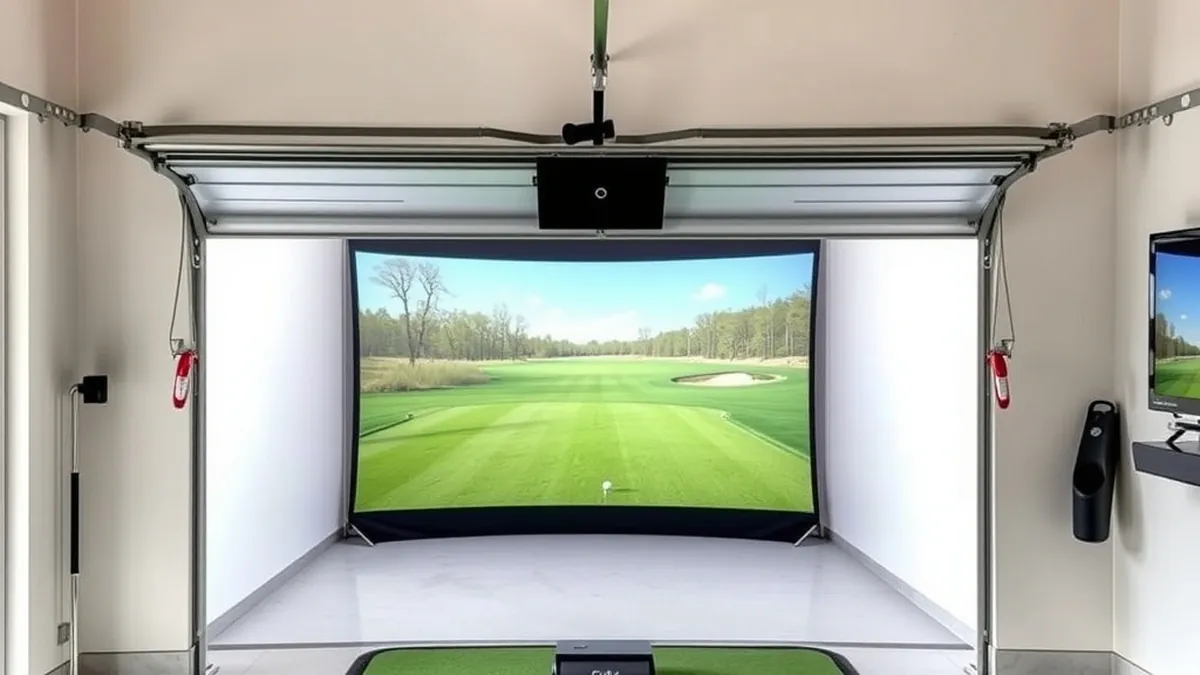
Measure from the floor to the lowest point of the door track, opener rail, or spring. If it is under 8 ft, plan a low-headroom kit, side-mount opener, or high-lift track before buying a screen.
- Typical track height
- 7 ft 6 in to 8 ft
- Driver clearance
- About 3 ft above player height
- Cheapest fix
- Move the hitting area
- Common hardware fix
- Side-mount opener, $800–$1,500
Some links on this page are affiliate links.If you buy through them we may earn a commission at no extra cost to you. We do not accept payment for rankings. Read the full disclosure.
Garage door clearance is the first measurement that decides whether a bay works. The ceiling can be 10 ft, but if the door track, opener rail, or spring hangs at 7 ft 6 in, that is the real limit on your swing. Measure the lowest obstruction, not the ceiling.
Clearance is the vertical distance from the floor to the lowest fixed object in the hitting area, measured with the door both open and closed.
What has to clear
Four pieces of door hardware usually compete for the same space. The horizontal track runs along each side of the ceiling. The opener rail runs down the center. The torsion spring sits above the door opening. The door panels themselves, when open, occupy the space under the ceiling.
The opener rail is the usual culprit in a two-car garage because it lands in the middle of the bay. The tracks are next, especially if they turn down toward the door with a tight radius. The spring is high enough to clear a swing but can block a projector mount or a ceiling-mounted launch monitor.
Measure all four, on both sides and at the center. Write down the lowest number. That number, not the ceiling height, is your planning constraint.
Measuring the lowest obstruction
Use a laser measure or a long straightedge and a tape. Measure from the floor to the bottom of the track where it crosses the hitting area. Repeat at the opener rail, the spring, and the open door panel.
Then measure the door’s travel path. A sectional door swings inward at the top as it opens, and the bottom panel can kick out. If the door opens toward the bay, the panel path matters as much as the static hardware.
Record three numbers: the lowest fixed obstruction, the ceiling height at the hitting area, and the distance from the ball to the screen. The first decides whether you can swing. The second decides whether you can mount a projector. The third decides whether the ball is still rising when it reaches the screen, which is a safety question. The room dimensions guide covers the depth and width numbers.
Standard door geometry
A standard 7 ft door with a 15 in radius track usually puts the horizontal track around 7 ft 6 in to 8 ft above the floor. The opener rail often hangs at 7 ft to 7 ft 6 in at its lowest point. An 8 ft door raises those numbers by about a foot.
The reference point in our ceiling height guide applies here: a driver needs about 3 ft of clearance above the player’s height, and irons need about 2 ft. A 6 ft player swinging a driver needs roughly 9 ft under the obstruction. A 7 ft 6 in track leaves 1 ft 6 in, which is not enough for a full swing.
Ball flight adds a second problem. At 8–10 ft from the ball, a driver is still climbing, and its apex can be near or above the track. A track across the flight path is a hard object in the ball’s way. Position the mat so the track is behind the player, or add an enclosure that contains the ball before it reaches the hardware.
Low-headroom kits
A low-headroom kit changes the track radius and the spring mounting so the door can operate in less space above the opening. It is the right fix when the ceiling is low and the door must keep working.
Expect a gain of roughly 3–6 in compared with a standard radius, and a cost of $300–$800 for parts or $600–$1,500 installed. The kit does not create headroom that is not there; it lets the door live in the space you have.
Low-headroom kits are common in older garages with 7 ft ceilings. They do not clear a golf swing, because the horizontal track still sits at roughly door height plus hardware.
Side-mount openers
A side-mount or jackshaft opener mounts on the torsion bar beside the door and drives the door through the shaft instead of a center rail. That removes the lowest center obstruction in most garages, which is often the single best change for a simulator bay.
The requirements are a torsion spring setup, a power outlet near the door, and about 6–8 in of side room. Extension-spring doors need a conversion first. A unit runs $400–$700, and installed cost is commonly $800–$1,500 including the torsion hardware.
A side-mount opener does not raise the tracks. If the tracks are at 7 ft 6 in, they are still at 7 ft 6 in. Measure both before you buy.
High-lift tracks and torsion changes
A high-lift conversion raises the horizontal track so the door travels higher before it turns. On a 10 ft ceiling, that can put the track at 9 ft or more and clear a driver swing.
The work involves new vertical track, a different radius, longer cables, and new torsion springs sized for the changed geometry. Expect $800–$2,000 installed, more if the ceiling or header needs modification.
This is not a DIY job. Torsion springs store enough energy to cause serious injury, and a door that is out of balance can fail suddenly. Use a garage door technician, and have the door’s reversal and safety sensors tested after the change.
Clearance solutions compared
| Solution | What it changes | Clearance gained | Typical installed cost | Best when |
|---|---|---|---|---|
| Move the hitting area | Nothing | Whatever the new spot allows | $0 | Track crosses only one part of the bay |
| Low-headroom kit | Track radius, spring mount | 3–6 in | $600–$1,500 | Low ceiling, door must work |
| Side-mount opener | Removes center rail | 6–12 in at center | $800–$1,500 | Opener rail is the low point |
| High-lift track | Raises horizontal track | 12–24 in | $800–$2,000 | 9–10 ft ceiling, door not used daily |
| Roll-up door | Removes overhead track | Full ceiling | $1,500–$4,000 | Renovation, maximum clearance |
| Disable and seal door | Removes all hardware | Full opening | $200–$600 | Door is never used for cars |
The cheapest solution is usually layout. If the door hardware is at one end of a two-car garage, put the bay at the other end and hit toward the wall. The two-car garage guide covers that split in detail.
Safety and code
Garage door hardware is heavy, spring-loaded, and governed by local code. Do not cut tracks, relocate springs, or disable the reversal system without a technician. The safety sensors are not optional.
If you stop using the door for parking, you still need to secure it. A locked door with the opener disconnected is a security barrier, and some insurers require it. Check with your insurer before you remove an opener or seal a door permanently.
Electrical work for a new opener outlet should be done by a licensed electrician under local code. If you are changing the header or adding a high-lift track that loads the framing differently, have the structure reviewed before the door is installed.
The short version
Measure from the floor to the lowest obstruction, not to the ceiling. If it is under 8 ft, expect to move the hitting area, fit a side-mount opener, or convert to high-lift tracks. Leave torsion springs to a garage door technician, and keep the door’s safety features working.
Frequently asked questions
How high is a typical garage door track?
Most residential doors with a 7 ft panel hang their horizontal track at roughly 7 ft 6 in to 8 ft above the floor. The opener rail often sits lower, around 7 ft to 7 ft 6 in, and the torsion spring sits above the door.
Can I swing a driver under a 7 ft 6 in track?
Usually not. A 6 ft player needs about 3 ft of clearance above their height for a driver, or 9 ft total. At 7 ft 6 in, even a 5 ft 6 in player has only 2 ft, which is iron territory at best.
Will a side-mount opener solve the problem?
It removes the center rail, which is often the lowest obstruction in the middle of the bay. It does not raise the door tracks, so measure those separately. A side-mount opener also needs a torsion bar and about 6–8 in of side room.
How much clearance does a high-lift track add?
A high-lift conversion raises the horizontal track toward the ceiling and typically gains 12–24 in under the track, depending on ceiling height and door panel height. It requires new springs and a technician to set the travel and balance.
Can I just remove the garage door opener?
You can remove an opener and operate the door manually, but the springs still store dangerous energy and the door still needs to balance and reverse correctly. Do not remove safety features or adjust torsion springs yourself.
Do I need a permit for garage door changes?
It depends on your local code and whether you change the header, tracks, or electrical circuit. A door technician or licensed contractor can tell you what your jurisdiction requires before work starts.
Sources
Some links are affiliate links.If you buy through them we may earn a commission at no extra cost to you. We do not accept payment for rankings. Read the full disclosure.