Photometric vs radar launch monitors
Cameras measure the ball at impact; radar tracks it through flight. The difference decides your room depth, lighting, club data, and price.
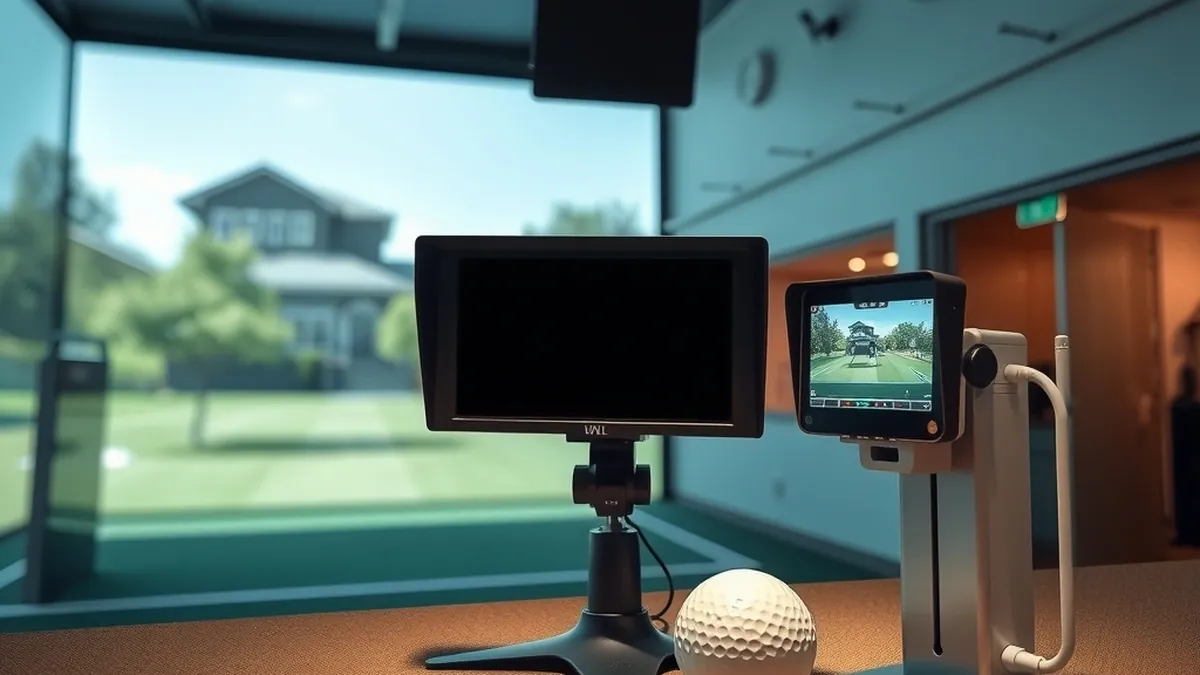
Photometric monitors measure the ball with cameras in the first inches after impact and suit rooms with 8 to 10 ft to the screen. Radar monitors track the flight with Doppler and need 8 to 10 ft of flight plus 6 to 8 ft behind the ball, but they usually cost less.
- Photometric strength
- Direct launch measurement in a short room
- Radar strength
- Full-flight tracking and lower entry price
- Photometric minimum depth
- About 8 ft ball to screen
- Radar minimum depth
- 8 to 10 ft of flight plus 6 to 8 ft behind
Some links on this page are affiliate links.If you buy through them we may earn a commission at no extra cost to you. We do not accept payment for rankings. Read the full disclosure.
| Photometric | Radar | |
|---|---|---|
| How it measures | High-speed cameras capture the ball at impact | Doppler radar tracks club and ball in flight |
| Indoor depth | About 8 ft from ball to screen | 8 to 10 ft of flight plus 6 to 8 ft behind |
| Indoor behavior | Measures launch conditions directly | Models part of a short flight |
| Lighting and setup | Needs a clean view and even light | Unaffected by light, bothered by metal and fans |
| Club data | Often added by radar or club markers | Measured directly from the clubhead |
| Typical price | $2,000 to $20,000 | $500 to $25,000 |
Photometric and radar launch monitors answer the same question with different physics. Cameras look at the ball at impact; radar watches the club and ball move. That single difference sets the room you need and the data you can trust.
A photometric launch monitor is a camera system that photographs the ball immediately after impact and calculates launch angle, ball speed, and spin from those images. A radar launch monitor is a Doppler sensor that tracks the clubhead and ball through flight and derives the same numbers from motion.
The short answer
If your bay is 8 to 10 ft from ball to screen, buy photometric. If you have 16 ft of depth and a $500 budget, buy radar. If you have the depth and the budget, the best answer is often one of each: a camera for indoor practice and a radar unit for the range.
The rest of this page explains why that split exists, and where the exceptions are.
How photometric monitors measure
A camera unit sits beside or slightly in front of the ball and fires a burst of high-speed images as the club passes. It sees the ball leave the face, measures the angle and speed, and reads the spin from the markings on the ball.
Because the measurement happens in the first few inches, the ball does not need to fly far. That is the technology’s indoor advantage: an 8 ft room still gives the camera a clean look at impact. The trade-off is that the camera must see the ball. A shadow, a scuffed cover, or a ball placed outside the hitting zone can produce a no-read.
Some units add infrared illumination so room light matters less. Others combine a camera with radar to add clubhead data the camera cannot see.
How radar monitors measure
A radar unit sits behind the player and watches the clubhead and ball with Doppler. It measures clubhead speed directly, then tracks the ball for as long as the room allows, using the observed flight to calculate launch, spin, and carry.
Outdoors, with 100 yards of flight, that is a strong method. Indoors, the unit may see only 8 to 10 ft before the screen. The rest of the trajectory is modeled, and the model is where the accuracy argument starts.
Radar is also sensitive to its surroundings. Metal framing, a ceiling fan, an air handler, or a garage door opener can create reflections. The unit does not care about light, which makes it a better fit for a dim garage.
What changes indoors
Indoor golf shortens the flight, and the two technologies respond differently. A camera measures the launch and lets the software calculate the rest. A radar unit measures part of the flight and calculates more of it.
That does not make radar wrong. A good radar unit with 10 ft of flight can produce useful, repeatable numbers, and many owners practice happily with one. But the shorter the flight, the more the numbers depend on the model, and the more a misread spin rate can distort carry.
Camera units have their own indoor weakness: they need a stable view. A mat that shifts, a ball teed outside the zone, or a shadow across the ball can cost a shot. Consistency of setup matters more than the monitor’s spec sheet.
Space behind and in front of the ball
Plan the bay around the sensor, not the other way around.
A photometric unit needs only a few feet around the ball; plan on 3 to 4 ft for the unit and the player, plus about 8 ft from ball to screen. A radar unit needs 6 to 8 ft behind the ball and 8 to 10 ft of flight. Add your backswing clearance on top of both.
That is why a 10 ft garage favors a camera and a 16 ft garage can run either. The room dimensions guide walks through the full envelope, including ceiling height and mat position.
Lighting, interference, and setup
Camera units want even light and a clean line of sight. Avoid direct sun across the hitting zone, hard shadows from a single bulb, and a glossy screen that throws light back at the lens. Infrared-assisted units are more forgiving, but they still need the ball in view.
Radar units want an unobstructed flight path and a quiet radio background. Keep them away from metal enclosures, moving fans, and other radar sources. They do not need light, so a dark garage is fine.
Neither unit likes vibration. Mount cameras on a stable surface, not a shelf that shakes when the ball hits the screen.
Club data and subscriptions
Radar measures the clubhead directly, so club path, face angle, and attack angle come naturally. That is why the cheapest radar units can still report path and face.
Camera units often need a second sensor or reflective club markers to get the same data. Some mid-price units add a radar module for exactly this reason. Others include club markers in the box and ask you to stick them on the face.
Subscriptions cut across both technologies. Course play, cloud history, and third-party simulator integration usually sit behind an annual plan, so compare the five-year cost, not just the hardware. The launch monitor buyer’s guide lists current plan ranges for five popular units.
The decision list
- Measure your depth first. Ball to screen, then behind the ball. Write both numbers down.
- Choose photometric if ball to screen is 8 to 10 ft, or if you want the most direct indoor launch measurement.
- Choose radar if you have 16 ft of depth, a $500 to $1,000 budget, or you need one unit for indoor and outdoor use.
- Choose a hybrid if you want camera ball data and radar club data in one box, such as the SkyTrak+.
- Choose overhead photometric if the room is shallow but the ceiling is 10 ft, such as the Uneekor EYE XO.
- Price the subscription and the PC before you commit. They can add more than the difference between the two technologies.
The short version
Photometric measures the ball at impact and fits the short room. Radar tracks the flight and fits the deep room, the outdoor range, and the tight budget. If you can only remember one rule, make it this: the room chooses the technology, not the other way around.
For the specific units that fit each category, start with the five launch monitor picks and then check the bay against the room dimensions. Price the rest of the build with the golf simulator cost breakdown before you choose a sensor.
Frequently asked questions
Which is more accurate, photometric or radar?
Neither wins everywhere. Photometric units measure launch conditions directly and tend to be more consistent in a short indoor flight. Radar units see the whole trajectory outdoors and can measure club speed directly, but indoor spin and carry depend more on the model.
Can a radar launch monitor work in a 10 ft room?
It can produce a shot, but it is working from a short flight. Radar wants 8 to 10 ft of ball flight and 6 to 8 ft behind the ball. In a 10 ft room, treat spin and carry as estimates and expect more variance than a camera unit would show.
Do photometric launch monitors need special balls?
Most consumer camera units work with any standard ball, though some club-data features need reflective markers on the clubface. Radar units generally work with any ball and do not need markings, which makes them easier for range use.
Does lighting affect a camera launch monitor?
Yes. A camera needs a clear, evenly lit view of the hitting zone. Direct sun, hard shadows, and a scuffed ball can cause no-reads. Many indoor units use infrared illumination to reduce the dependence on room light, but setup still matters.
Why do radar units cost less?
A single Doppler module is cheaper to build than multiple high-speed cameras and the processing that goes with them. Radar also gives up some indoor precision at the low end, which is why the cheapest units are radar and the most accurate indoor units are cameras.
Which type should I buy for a garage bay?
A camera unit is usually the better fit because it needs less flight and sits beside the ball. Choose radar only if the garage is deep enough for 8 to 10 ft of flight and 6 to 8 ft behind the ball, or if you will also use the unit outdoors.
Sources
Some links are affiliate links.If you buy through them we may earn a commission at no extra cost to you. We do not accept payment for rankings. Read the full disclosure.